Your First Step to Better Sports Vision: Understanding the Performance Check

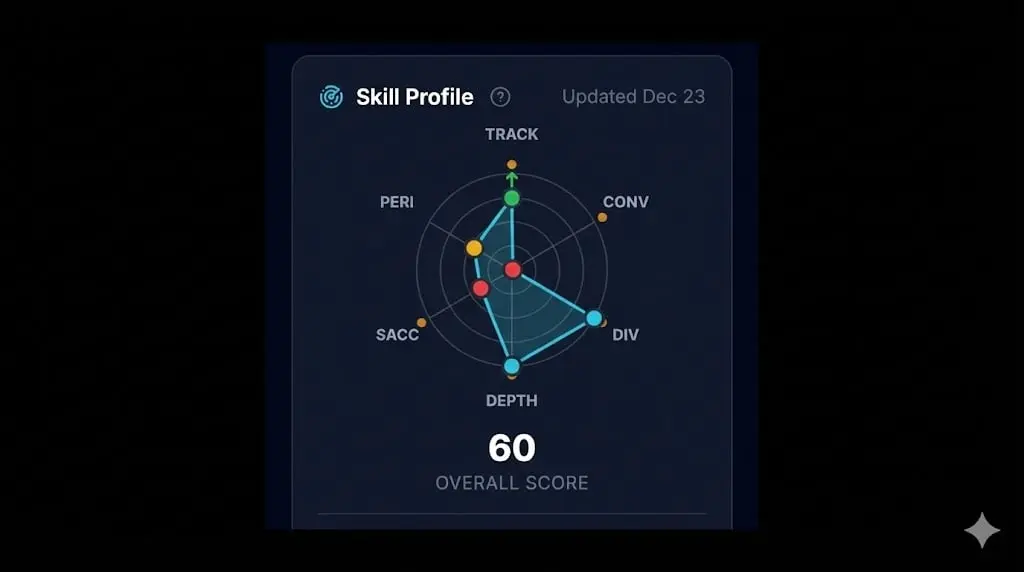
Before you start any serious training program, you need to know where you are starting from. A basketball player does not just show up and start shooting threes without understanding their current shooting percentage. A sprinter times their baseline 100-meter dash before designing a speed program.
Sports vision training works the same way.
The Performance Check is your starting line—a comprehensive assessment that maps your current visual-motor abilities across seven dimensions. It gives you (and the app) the information needed to create training that fits you, not some generic program.
Most people have no idea where they stand with their visual skills. You might have excellent depth perception but sluggish eye movement speed. Maybe your peripheral awareness is sharp, but your eyes struggle to converge on close objects. Without testing, you would never know—and you would waste time training skills that are already strong while neglecting the ones holding you back.
The Performance Check establishes your personal ceiling in multiple visual dimensions. These become the foundation for your training zones, ensuring every session challenges you at the right intensity. Too easy and you will not improve. Too hard and you will just get frustrated. The sweet spot is where real progress happens.
Getting started:
When you first startup 3DVisionGym the final intro slide will give you an opportunity to start the Performance Evaluation:

Or you can always return from the bottom of the training program menu

The assessment takes about 10-15 minutes. You will move through seven phases, with short rest breaks between each. Here is what each one involves:
Stereo Calibration
Your setup phase. You will adjust the 3D depth intensity while wearing your anaglyph glasses until the image feels comfortable and clear. Think of it like adjusting binoculars - you are finding your optimal viewing level. No right or wrong answer here. For the detail minded - this sets how far off the “odd man out” disk is during divergence, convergence, and jump-duction activties.
Divergence Test
Four circles appear on screen. Your job: identify which one looks farthest away. The test adapts as you go - get it right, and it gets more subtle. The algorithm hunts for your ceiling: the finest depth difference you can reliably detect when objects recede into the distance.
Saccadic Test
Things speed up. Targets appear rapidly in different locations, and you tap them (or press arrow keys) as quickly and accurately as you can. This measures your ability to snap your eyes to new targets—crucial for tracking a ball, reading a defense, or spotting an open teammate. The test finds your comfortable speed level on a 1-6 scale.
Convergence Test
Similar to divergence, but flipped. Now you are identifying which circle appears closest. This tests your eyes' ability to work together when focusing on approaching objects—catching a pass, fielding a grounder, judging when to swing.
Tracking Test
A target moves across the screen and you follow it with your eyes only (no head movement). Afterward, you provide feedback on how well you tracked it. This self-assessment helps the app understand your smooth pursuit abilities—how well your eyes stay locked on moving objects.
Peripheral Test
This is where it gets interesting. You focus on a central point while detecting flashes in your peripheral vision. This dual-task design tests divided attention—can you maintain center focus while still picking up what is happening at the edges? Athletes with strong peripheral awareness seem to have eyes in the back of their heads.
Depth of Field Test
The final phase. Five rings at very subtle depth differences. This fine-grained assessment pushes your depth perception to its limits, measuring how precisely you can distinguish objects at nearly identical distances.
Understanding Your Results
After completing the Performance Check, you receive a zone classification for each dimension:
Developing — You are at the beginning in this area. This is not a judgment; it is information. Everyone starts somewhere, and plenty of elite athletes were "developing" in certain visual skills before they trained them.
Progressing — You have a foundation to build on. Your skills are functional, and targeted training will push them further.
Proficient — You are performing well in this dimension. At or above what most people would consider solid visual ability.
Advanced — You are operating at a high level. Training will focus on maintaining this edge and pushing into elite territory.
These zones are not permanent labels. They are snapshots. A "Developing" classification today can become "Proficient" with consistent training. That is literally the point.
Setting Yourself Up for Success
A few tips for accurate results:
Take it seriously, but do not stress. Treat this like any athletic assessment—genuine effort, but understand that anxiety will skew results. Respond naturally.
Use the rest breaks. Those 15-second pauses exist for a reason. Let your eyes recover. Look away from the screen. Blink. The next phase will be waiting.
The test adapts to find your limits. You are supposed to reach a point where things get difficult. That is how the algorithm identifies your ceiling. Missing some responses near the end does not mean you failed—it means the test did its job.
Your first results are not your final results. Consider retaking the Performance Check every few weeks to track progress. Watching those zones shift upward is one of the most motivating parts of training.
A Quick Note
The Performance Check is an assessment tool designed to personalize your training experience. It is not a medical examination, clinical diagnosis, or substitute for professional eye care. If you have concerns about your vision or eye health, consult a qualified eye care professional.
What it is: a smart, adaptive way to understand your visual-motor abilities so you can train more effectively.
Now put on those glasses, find a comfortable spot, and discover where your sports vision journey begins.