Your Daily Training, Explained: How 3DVisionGym builds a workout just for you

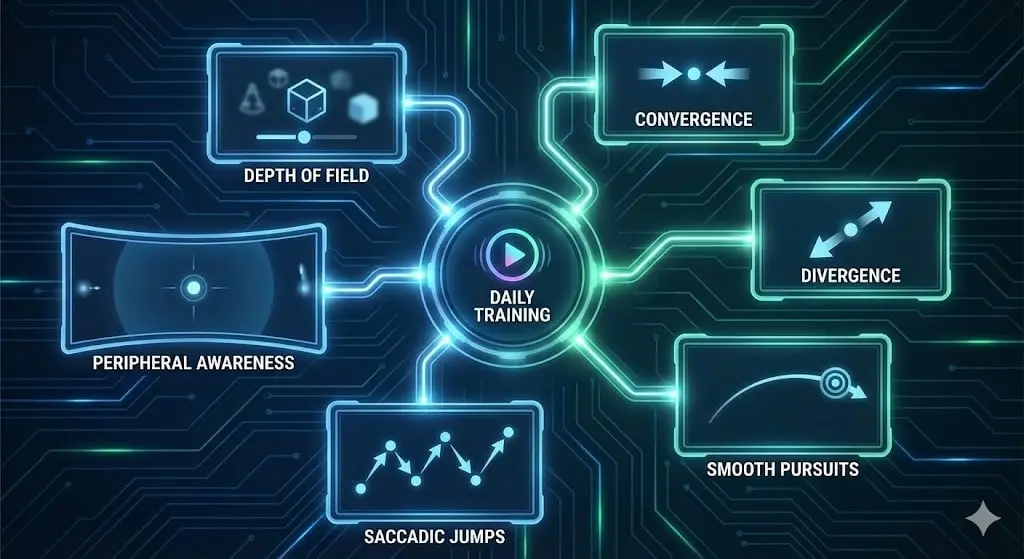
Why personalized training beats generic workouts—and how the system adapts to you
Why personalization matters
You use a personal trainer at the gym because they are directing your exercises to align with your goals and improve weaknesses. 3DVisionGym's Daily Training is similar. Every session is built for you—your sport, your position, your current skill levels, and yes, even how consistently you have been showing up. Here is how it works.
Think about what your eyes do during competition. A baseball outfielder tracking a fly ball against a cloudy sky is solving a completely different visual problem than a point guard reading a fast break. The outfielder needs exceptional depth perception and the ability to judge distance as the ball approaches. The point guard needs to see the whole court at once while making split-second decisions.
Generic vision training ignores this. Personalized training recognizes that a hockey player's eyes need to be sharp at different things than a golfer's. And within each sport, a catcher has different visual demands than a center fielder.
When you tell 3DVisionGym your sport and position, you are not just filling out a profile. You are telling the system which visual skills matter most for what you do on the field, court, or ice.
How Your Sport Changes Everything
Baseball and softball demand the whole package. Tracking a 95-mph fastball, reading spin out of the pitcher's hand, judging whether that fly ball is catchable—these sports stress every visual dimension almost equally. There is no hiding a weakness when you are facing live pitching.
Hockey is all about speed and chaos. The puck moves faster than almost any ball in sports, and there is traffic everywhere. The system prioritizes rapid eye movements (saccadic function) and peripheral awareness at maximum levels. You need to find the puck instantly and know where the open ice is without looking directly at it.
Basketball emphasizes court vision. That peripheral awareness that lets a point guard thread a pass through traffic? That is trainable. The system also prioritizes quick visual reactions for reading fast breaks and defensive rotations.
Golf is the opposite extreme. You are not tracking anything moving at high speed. Instead, you need exceptional depth perception and the ability to estimate distances accurately—from reading greens to judging how far that flag really is. The system de-emphasizes rapid reaction skills and focuses on what matters for your game.
Soccer depends heavily on position. Midfielders need near-360-degree awareness to receive passes under pressure. Goalkeepers need to track shots while monitoring the entire penalty area. Forwards benefit from precise depth judgment when finishing in tight spaces.
Tennis combines convergence (tracking a ball coming right at you) with rapid lateral eye movements to follow shots across the court.
When you select your sport and position, the system adjusts its priorities accordingly. An outfielder's workout looks different from a catcher's, even though they play the same sport.
Your Performance Check Sets the Foundation
Before Daily Training can help you improve, it needs to know where you are starting. The Performance Check evaluates your baseline across six visual dimensions and places each one in a zone: Developing, Progressing, Proficient, or Advanced.
(If you have not read our deep dive on the Performance Check, that is worth a look for the full picture.)
This evaluation creates your personal skill profile. But the system does not just identify weaknesses—it weighs them against what your sport requires. A "Developing" score in peripheral vision matters a lot more for a hockey player than a golfer. The system knows this and adjusts accordingly.

Every Workout Has a Purpose
Your Daily Training session runs about 10-12 minutes and includes six exercises. That is not arbitrary—it is structured intentionally:
Warmup – Every session starts with smooth pursuit exercises at reduced speed. This gets your eyes ready for work without jumping straight into high-intensity drills.
Focus Exercises – These target your biggest opportunities for improvement. The system calculates a "weakness score" that considers how far you are from proficiency, your recent trend, how long since you trained that skill, and how important it is for your sport.
Sport-Critical Exercises – Even if you are proficient in a skill, if it is essential for your sport, you will maintain it. A baseball player does not stop working on tracking just because they have hit "Proficient."
Maintenance Exercises – Other skills get touched regularly to prevent backsliding.
Cooldown – Every session ends properly, not abruptly.
The System Learns From You
3DVisionGym does not just remember your last assessment—it tracks how you perform in training, too.
Do well in a session? Your starting difficulty for that skill adjusts upward next time. Take a week off? The system accounts for that rust and does not throw you into the deep end. It blends your assessment data with your training performance, weighing recent sessions more heavily than older ones.
This creates a feedback loop: you train, you improve, the system notices, and your next workout reflects that progress. Over time, your Daily Training evolves with you rather than staying static.
Consistency Is the Multiplier
Sporadic effort produces sporadic results. The athletes who see real improvements are the ones who show up regularly.
The system rewards consistency. When you train regularly, it has fresh data to work with. It can track trends, recognize improvement, and keep you challenged at the right level. When you disappear for two weeks, it has to make more assumptions—and those assumptions are conservative.
Ten minutes a day, most days, beats an hour once a week. The structure is already built for you. All you have to do is start the session.
What to Expect
When you open Daily Training, you will see a workout tailored to exactly where you are today - your sport, your position, your skill levels, your recent training history. Six exercises. About 10-12 minutes. Warmup to cooldown.
It is not random. It is not generic. It is yours.
A note on what we are (and are not): 3DVisionGym is a training tool for visual skills relevant to athletic performance—not a medical device. It does not diagnose, treat, or prevent any medical condition. If you have concerns about your vision or eye health, see a qualified eye care professional.