Training Your Eyes to Work as a Team: Vergence for Athletes

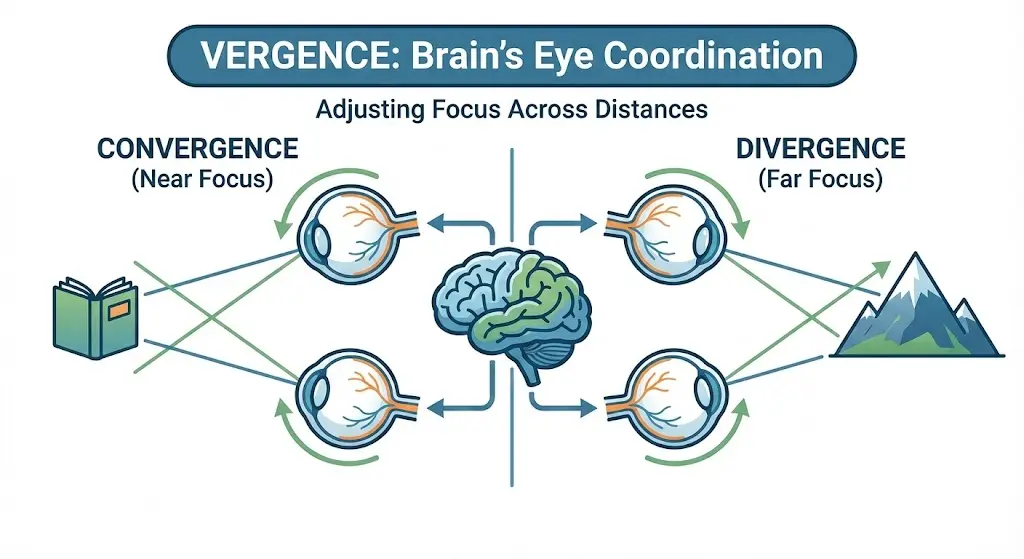
How your brain coordinates depth perception—and why it matters for sports performance
Vergence?
Vergence is your brain's ability to coordinate both eyes so they move in opposite directions—toward each other or away from each other—to lock onto objects at different distances. Every time you shift focus from far to near (or back again), your vergence system kicks in. It happens so fast, so automatically, that you never think about it.
Athletes should think about it.
Why Vergence Matters When the Ball Is Moving at 90 MPH
Depth perception is not static. A tennis ball does not politely hold still while you figure out where it is in space. Neither does a fastball, a volleyball, or a cross into the box.
Your vergence system tracks objects as they move toward you, away from you, or across your field of vision at varying depths. When a pitcher releases, your eyes converge rapidly to follow the ball as it approaches. When an outfielder tracks a fly ball, they diverge slightly as it arcs upward and away.
Athletes with well-trained vergence systems:
- Pick up the ball earlier out of the pitcher's hand
- Judge the speed and trajectory of approaching objects more accurately
- Make cleaner contact because they are tracking all the way to the bat, racket, or hands
- React faster when the play involves multiple depth planes
The gap between good and great often comes down to milliseconds. A faster vergence system shaves crucial time off your visual processing—giving you that extra fraction of a second to react.
Convergence vs. Divergence: Two Sides of the Same Coin
Think of vergence like a dial that turns in two directions.
Convergence is when your eyes rotate inward, toward your nose. This happens when you focus on near objects. It is what your eyes do when tracking a pitch coming toward home plate, a serve screaming across the net, or a pass arriving at your chest. Whenever an object moves from far to near, convergence does the heavy lifting.
Divergence is the opposite—your eyes rotating slightly outward to focus on distant objects. It is what happens when you look up from a book to gaze out the window, or when you are tracking a punted football sailing away, or shifting your gaze from the ball at your feet to a teammate fifty yards upfield.
Most people favor one over the other. Some converge efficiently but struggle with divergence; others have the opposite pattern. Training both matters because sports constantly demand transitions between near and far focus—often within fractions of a second.
Jump Ductions: Where It Gets Interesting
If convergence and divergence are the fundamentals, jump ductions are the advanced drill.
Jump ductions involve rapidly alternating between near and far focus—switching between convergence and divergence as quickly as possible. This mirrors actual competition: a batter tracks the pitcher's release point (far), shifts to the ball in flight (mid-distance, moving closer), follows it to the contact zone (near), then immediately looks up to see where it went (far again). All of this happens in under a second.
Training your eyes to make these transitions smoothly and quickly pays off. The goal is not just accuracy at each depth—it is reducing the lag time when switching between them. Think of it like training fast-twitch muscle fibers, but for your oculomotor system.
Jump ductions are harder than pure convergence or divergence work, which is why they are typically introduced after you have built a foundation with the individual movements.
What Progress Actually Looks Like
Visual training is not like lifting weights—you cannot watch your biceps grow. The improvements are subtler, and they show up in performance rather than the mirror.
Early on, you will notice exercises feel easier and you complete them faster. Levels that felt challenging become routine. Over weeks and months, many athletes report picking up visual information faster during competition—seeing the ball earlier, tracking it more cleanly, feeling less "late" on reactions.
Some users advance through hundreds of levels, reflecting genuine gains in vergence control and speed. The eye muscles and neural pathways involved are trainable, just like any other part of your motor system.
Progress is not always linear, though. Some days your eyes feel sharp; others, sluggish. Fatigue, screen time, even hydration can affect visual performance. Consistency matters more than any single session.
Using a Vergence program in 3D Vision Gym
Regardless of the vergence program you'll be shown 4 circular disks. Wearing your 3D glasses you should work to bring the set of disks into focus. One will be closer to you. Select the disk (using the arrow keys, tablet tap, or mouse click) that appears closest. When using the keyboard use the arrow corresponding to the relative direction of the disk (up, down, left or right). When you're successful most programs will increase difficulty and when you miss the challenge will be backed off.
A Note on Expectations
These exercises are designed to improve functional visual skills—the kind that help with sports performance and everyday tasks. They are not medical treatments, and they do not replace professional eye care. If you have concerns about your vision or eye health, see an optometrist or ophthalmologist.
What vergence training can do is help you get more out of the visual hardware you already have. For athletes looking to sharpen depth perception and track fast-moving objects more effectively, it is one more tool in the training kit—and one that is often overlooked.
Your eyes are trainable. Put them to work.
Visual training exercises are designed to challenge and develop eye movement skills. They are not medical treatment and do not replace professional eye care. If you have concerns about your vision or eye health, consult a qualified eye care professional.