The Yips: Is It a Vision Problem?
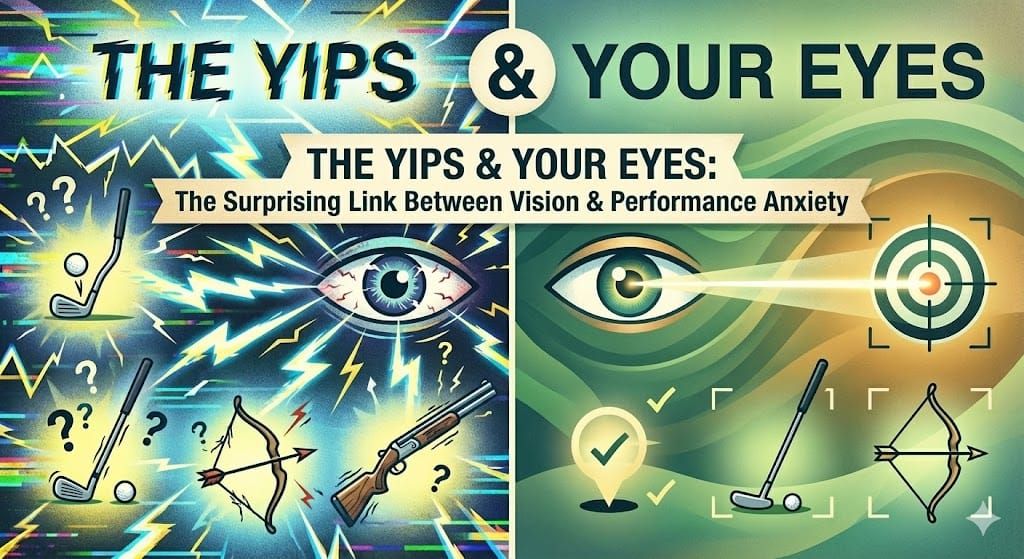
It starts small. A twitch on a short putt. A flinch before you release the arrow. A freeze right before you pull the trigger.
Then it gets worse.
Golfers call it the yips. Archers call it target panic. Whatever the name, the pattern is the same: a skill you've done thousands of times suddenly falls apart.
The yips have ended careers. Pro golfers have quit rather than face another three-foot putt. Competitive archers have walked away from the sport. Shooters have watched their scores collapse.
For years, people dismissed the yips as a mental problem - just nerves, lack of confidence, something to push through. Research now shows it's more complicated. And part of the story involves your eyes.
What Actually Happens
The yips show up in three main ways:
Freezing – You can't finish the movement. Archers can't reach full draw. Golfers freeze over the ball.
Twitching – An unwanted jerk disrupts the action. The putter moves at impact. The bow hand flinches.
Early release – The shot fires before you're ready. The arrow leaves too soon. The trigger seems to pull itself.
Researchers divide these into two categories. Some cases look neurological - repeated movements eventually cause the motor circuits to misfire. Other cases look psychological - anxiety disrupts automatic movements.
Most athletes have some of both. A 2015 review found the yips exist on a spectrum, with pure physical causes on one end and pure anxiety causes on the other.
Where Vision Enters the Picture
Dr. Joan Vickers studies what happens to gaze control under pressure. Her research shows something important: anxiety doesn't just affect your thoughts. It changes how you look.
Athletes under high anxiety show shorter, jumpier eye fixations. Their Quiet Eye - that steady, focused gaze experts use before precise movements - gets disrupted. The eyes jump around. Focus shifts too early. Visual control breaks down.
In 2022, Vickers published a case study about an LPGA golfer who developed the yips in her 13th season. The golfer said anxiety made focusing difficult. Her eye movements became something she worried about, which made them worse.
After training to stabilize her gaze on the ball before and during her stroke, she had her second-best season. The improvement didn't last permanently (the training was done remotely during the pandemic). But it showed a connection: fixing gaze control helped fix putting.
Why Gaze Matters for Motor Control
When you putt, shoot, or draw a bow, your brain uses visual information to guide the movement. Research shows experts hold their gaze steady on the target longer than beginners do. This extended fixation connects to better accuracy.
The leading theory: stable gaze helps your brain plan the movement without interference. It may also help filter out distracting information.
When anxiety disrupts gaze control, it disrupts this planning. Your eyes send noisy, inconsistent data. Your motor system gets mixed signals. The result feels like your hands don't know what to do.
Here's an interesting detail: many archers report that shooting with eyes closed feels smoother than shooting with eyes open. A common target panic drill is "blank bale" shooting - drawing and releasing at a close target with no aiming point. Removing visual information entirely can sometimes break the cycle.
This supports the idea that the problem isn't purely mechanical. It's in how vision and movement interact.
What Helps
No single treatment works for everyone. But several approaches show promise:
Gaze training – Practice holding a steady fixation point for an extended period before and during your movement. Early research suggests this can protect against anxiety-related breakdowns.
Process focus – Shift attention from outcome (make the putt) to process (execute the routine). This reduces the self-focus that disrupts automatic skills.
Dual-task techniques – Occupy your conscious mind with a secondary task like humming or counting. This prevents over-analysis of the movement.
Equipment changes – Some golfers overcome the yips by switching grips. Some archers switch to back-tension releases that remove the conscious trigger decision. These may work by creating fresh motor patterns without built-up anxiety.
Slow rebuilding – Practice without targets. Blank-bale shooting for archers. Short putts for golfers. Rebuild confidence without triggering the disruption.
The Bottom Line
The yips aren't purely a vision problem. Anxiety, motor learning, and neural patterns all play roles.
But gaze behavior appears to be one lever connecting psychology to performance. When anxiety disrupts how you look at the target, it may disrupt the motor planning that depends on stable visual input.
This suggests gaze training might help manage the yips - not as a cure, but as one piece of the puzzle.
If you've struggled with this, you're not alone. Studies suggest 30-50% of experienced golfers experience the yips at some point. The condition is real, common, and treatable.
Your eyes might be part of the problem. They might also be part of the solution.
Research References
- Vickers JN (2022). Quiet Eye training alleviates the yips in golf putting: a research proposal. Brazilian Journal of Motor Behavior. Full Text
- Smith AM et al. (2003). The 'yips' in golf: A continuum between a focal dystonia and choking. Sports Medicine. PubMed
- Clarke P, Sheffield D, Akehurst S (2015). The yips in sport: A systematic review. International Review of Sport and Exercise Psychology. DOI
- Behan M, Wilson M (2008). State anxiety and visual attention: The role of the quiet eye period in aiming to a far target. Journal of Sports Sciences. PubMed
These exercises challenge and develop eye movement skills. They are not medical treatment. If you have concerns about your vision, see a qualified eye care professional.