The Quiet Eye: The Gaze Pattern That Separates Good From Great
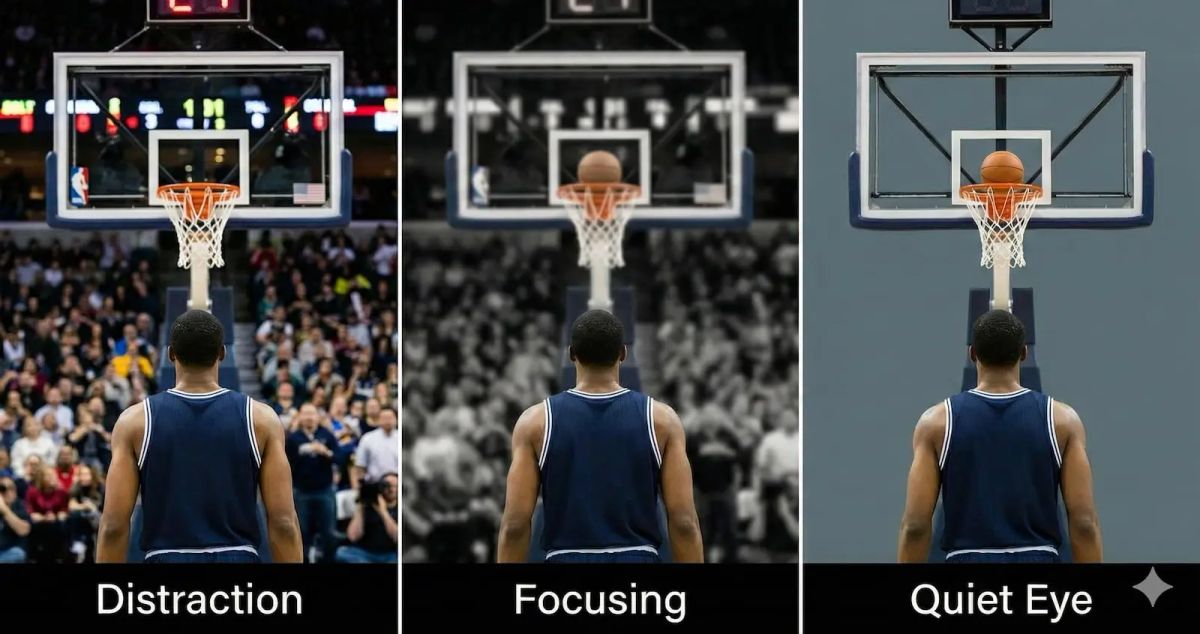
Watch a professional golfer in the seconds before they putt. Or a basketball player at the free throw line. Or an Olympic trap shooter before they call for the bird. There's a stillness there, a locked-in focus that's easy to dismiss as concentration or confidence.
But it's something more specific than that. And over three decades of research, it's emerged as one of the most consistent predictors of who makes the shot and who doesn't.
Today’s post goes outside the bounds of tools available within 3DVisionGym.com. But it’s an incredibly useful tool that athletes should know about - a key vision based tool for upping performance. At times it almost seems too good (or too simple) to be true.
What Is the Quiet Eye?
The Quiet Eye (QE) is a specific gaze behavior: a final fixation or tracking gaze directed at a critical target, occurring just before the initiation of a motor action. It was discovered by Dr. Joan Vickers at the University of Calgary in 1992 while studying golfers making putts. She noticed something unexpected: the best performers weren't processing visual information faster than everyone else. They were doing the opposite - holding their gaze still, longer, on a single location.
The formal definition, refined over decades of research, is precise: a fixation lasting at least 100 milliseconds, within 3 degrees of visual angle, on a specific location or object in the performance space, with onset occurring before the final movement begins.
But here's what makes it remarkable: across dozens of sports and hundreds of studies, the same pattern emerges. Elite performers have longer Quiet Eye durations than near-elite performers. And successful attempts have longer Quiet Eye durations than misses - even within the same athlete.
This isn't correlation. Researchers have trained athletes to extend their Quiet Eye, and their performance improves. They've disrupted the Quiet Eye, and performance degrades. It's causal.
The Numbers
The differences aren't subtle. In basketball free throws, Vickers found that elite shooters maintained fixation on the rim for an average of 972 milliseconds before initiating their shot. Sub-elite players? Just 357 milliseconds.
In golf putting, highly skilled players (handicap under 4) hold their Quiet Eye on the ball for 2.5 to 3 seconds- one second before the backswing, one second during the stroke, and a half second after contact. Higher-handicap golfers average just 1 to 1.5 seconds.
In shotgun sports (skeet, trap, double trap), elite shooters demonstrate both an earlier onset and longer duration of Quiet Eye than sub-elite shooters. One study with international skeet shooters found that eight weeks of Quiet Eye training improved average scores by 20%- from 60 to the 70s - while a control group practicing without QE training showed no improvement.
These differences exist across virtually every aiming task studied: archery, darts, billiards, penalty kicks, ice hockey goaltending, rifle shooting, and surgical procedures. The Quiet Eye is, as one meta-analysis put it, one of only three gaze behaviors that reliably distinguish experts from non-experts.
What's Actually Happening in Those Extra Milliseconds?
The leading theory is that the Quiet Eye represents the time needed for the brain to organize the neural networks that control the upcoming movement. It's not passive observation-it's active preparation.
During a long Quiet Eye fixation, the brain's dorsal attention network (responsible for goal-directed focus) is fully engaged, while the ventral attention network (which responds to unexpected stimuli and distractions) is suppressed. This creates a state of focused attention that allows motor programming to proceed without interference.
Think of it as giving your brain's autopilot the runway it needs to take off smoothly. Cut that runway short, and the flight gets bumpy.
There's also evidence that the Quiet Eye provides an external focus of attention-you're focused on the target, not on your body mechanics. This aligns with research by Gabriele Wulf showing that external focus ("hit that spot") outperforms internal focus ("keep your elbow straight") across virtually all motor tasks. The Quiet Eye may be the visual mechanism that enables this external focus to happen naturally.
Sport-Specific Examples
Basketball: The Free Throw
The basketball free throw is where Quiet Eye research began, and it remains one of the clearest demonstrations of the effect.
Elite free throw shooters fixate on the front of the rim (the target) earlier in their pre-shot routine and hold that fixation longer than less skilled shooters. The Quiet Eye begins before the ball leaves their hands-during the "gathering" phase when the arms are preparing to extend-and continues through the release.
When researchers trained university basketball players using Quiet Eye techniques, their shooting accuracy improved from 63% in pre-testing to 77% in post-testing. But here's what's even more interesting: the improvement was most pronounced under pressure. When anxiety was introduced (competitive conditions, consequences for missing), the Quiet Eye-trained group maintained their performance while control groups fell apart.
The Quiet Eye appears to be a buffer against choking.
Golf: The Putt
Golf putting may be the most thoroughly studied Quiet Eye task. The optimal pattern looks like this:
- Final fixation on the back of the ball
- Hold for approximately 1 second before initiating the backswing
- Maintain fixation throughout the stroke
- Continue fixating on the spot where the ball was for another 200-500 milliseconds after contact (this is called "QE dwell time")
Highly skilled golfers do this naturally. Lower-skilled golfers tend to shift their gaze once the stroke begins-their eyes jump to the target too early, or they track the putter head, or they look up to see where the ball is going before they've finished the stroke.
Studies show that Quiet Eye training helps golfers not just in practice, but specifically under pressure conditions. One study with elite golfers (handicaps 0-4) found that QE training improved accuracy in a laboratory putting task, and critically, protected performance during a pressure test where the control group's accuracy declined.
Shotgun Sports: Trap, Skeet, and Sporting Clays
Clay target shooting presents a unique challenge for Quiet Eye research because the target is moving. You can't fixate on a stationary point-you have to track a flying clay.
The adaptation in these sports is that the Quiet Eye occurs in the moments before calling for the target. Elite shooters establish a steady, relaxed gaze at a specific point in space-typically slightly in front of the trap house, along the expected flight path-and hold that fixation before calling "pull." This is sometimes called establishing "soft focus" before target acquisition.
Research on international skeet, trap, and double trap shooters found that elite performers demonstrated both earlier onset and longer duration of this pre-shot Quiet Eye compared to sub-elite competitors. Elite shooters also used slower, more controlled gun movement once the target appeared.
Olympic shooting coach Les Greevy has incorporated Quiet Eye into pre-shot routines, emphasizing stillness and mental quieting before calling for the bird. The idea is to let the conscious mind settle so the trained reflexes can take over.
One practical technique: practice holding your gaze on a distant fixed point for 10 seconds while holding your shotgun in shooting position. Work up to 20 repetitions. This builds the gaze stability that precedes effective target tracking.
Soccer: The Penalty Kick
Penalty kicks introduce a wrinkle: the goalkeeper. Where should the kicker look? At the target (the corner of the goal)? At the goalkeeper to read their movement? At the ball?
Research from the University of Exeter found that better penalty takers use a "target-focused" strategy-they fixate on where they want the ball to go-while poorer shooters use a "goalkeeper-focused" strategy, watching the keeper and reacting.
The Quiet Eye in penalty kicks occurs on the ball in the final moments before the approach. Successful penalties are characterized by longer Quiet Eye duration and later Quiet Eye offset (meaning the eyes stay on the ball longer before looking up). Unsuccessful penalties show shorter Quiet Eye and earlier offset-the kicker's gaze leaves the ball too soon, often to watch the goalkeeper.
In one study, Quiet Eye-trained penalty takers had 50% fewer shots saved compared to a control group. Their kicks were more accurate (hit wider in the goal, away from the goalkeeper's reach), and critically, they reported feeling more in control under pressure.
The takeaway: commit to your target before you approach the ball. Lock your gaze. Let your body execute what your eyes have programmed.
Why the Quiet Eye Breaks Down Under Pressure
One of the most consistent findings in Quiet Eye research is that anxiety disrupts the gaze. When athletes are nervous, their Quiet Eye duration shortens, their gaze becomes more erratic, and their fixations scatter across multiple locations instead of holding steady on the target.
This is consistent with attentional control theory: anxiety shifts attention from goal-directed processing (what you want to do) to stimulus-driven processing (reacting to whatever grabs your attention). The goalkeeper becomes more salient. The consequences of missing become more intrusive. Your eyes start hunting instead of locking.
The good news is that Quiet Eye training appears to provide protection against this effect. Athletes who have practiced maintaining their gaze under calm conditions can better maintain it under pressure. The skill transfers.
Training the Quiet Eye
The research suggests several practical approaches:
Awareness first. Most athletes have never thought about where their eyes go during performance. Simply becoming aware of your gaze behavior is the first step. Video feedback with eye-tracking data is ideal if available; otherwise, a coach or training partner can observe whether your head and eyes stay still or move during critical moments.
Extend fixation duration. Practice holding your gaze on the target longer than feels natural. In golf, fixate on the ball for a full 2-3 seconds before initiating the stroke. In basketball, lock onto the rim earlier in your pre-shot routine. In clay shooting, establish a stable visual hold point before calling for the target.
Maintain fixation through the action. Resist the urge to look at the outcome before you've completed the movement. Keep your eyes on the ball through contact. Keep your eyes on the spot where the ball was after contact. Let your peripheral vision catch the result.
Practice under pressure. The benefits of Quiet Eye training are most evident in high-pressure situations. Introduce consequences during practice-competition, stakes, distractions-and focus on maintaining your gaze behavior when it matters most.
Use it as a mental anchor. When anxiety spikes, the Quiet Eye gives you something controllable to focus on. Instead of trying to calm your nerves (which rarely works), redirect attention to your gaze. "Lock onto the target" is a more actionable instruction than "relax."
The Bigger Picture
The Quiet Eye matters because it reveals something fundamental about how vision and action are coupled. We don't just see and then act as separate processes. Vision programs action. The information flowing through your eyes in those final moments before movement is shaping what your motor system does.
The practical implication is straightforward: if you want to improve where your body goes, start by training where your eyes look-and how long they stay there.
This has implications beyond sports. Surgeons with longer Quiet Eye durations make fewer errors during complex procedures. Police officers with better gaze control make more accurate shoot/don't-shoot decisions. Anywhere precision matters under pressure, the principles apply.
But for athletes, the message is simple: your eyes lead. If you want to improve where your body goes, start by training where your eyes look-and how long they stay there.
Visual training exercises are designed to challenge and develop eye movement skills. They are not medical treatment and do not replace professional eye care. If you have concerns about your vision or eye health, consult a qualified eye care professional.
Further Reading
For those who want to go deeper into the research:
Foundational Work:
- Vickers, J.N. (1996). Visual control when aiming at a far target. Journal of Experimental Psychology: Human Perception and Performance, 22(2), 342-354. PubMed | PDF
- Vickers, J.N. (2007). Perception, Cognition, and Decision Training: The Quiet Eye in Action. Human Kinetics. [Book]
Key Meta-Analyses:
- Mann, D.T.Y., Williams, A.M., Ward, P., & Janelle, C.M. (2007). Perceptual-cognitive expertise in sport: A meta-analysis. Journal of Sport & Exercise Psychology, 29, 457-478. PubMed | PDF
- Lebeau, J.C., et al. (2016). Quiet eye and performance in sport: A meta-analysis. Journal of Sport & Exercise Psychology, 38(5), 441-457. PubMed
Sport-Specific Studies:
- Causer, J., et al. (2010). Quiet eye duration and gun motion in elite shotgun shooting. Medicine & Science in Sports & Exercise, 42(8), 1599-1608. PubMed
- Vine, S.J., Moore, L.J., & Wilson, M.R. (2011). Quiet eye training facilitates competitive putting performance in elite golfers. Frontiers in Psychology, 2, 8. Full Text (Open Access)
- Wood, G. & Wilson, M.R. (2011). Quiet-eye training for soccer penalty kicks. Cognitive Processing, 12, 257-266. PubMed
- Vickers, J.N., Causer, J., & Vanhooren, D. (2019). The role of quiet eye timing and location in the basketball three-point shot. Frontiers in Psychology, 10, 2424. Full Text (Open Access)
Recent Reviews:
- Rienhoff, R., et al. (2016). The 'Quiet Eye' and motor performance: A systematic review. Sports Medicine, 46(4), 589-603. PubMed
- Vickers, J.N. (2016). Origins and current issues in Quiet Eye research. Current Issues in Sport Science, 1, 101. Full Text (Open Access)
The Quiet Eye is one of the most robust findings in sports vision research. Whether you're a golfer working on your putting, a basketball player at the line, or a clay shooter looking to break more targets, your gaze behavior may be the highest-leverage skill you're not currently training.