The Aging Athlete's Eyes: What Declines, What Stays, and What You Can Do

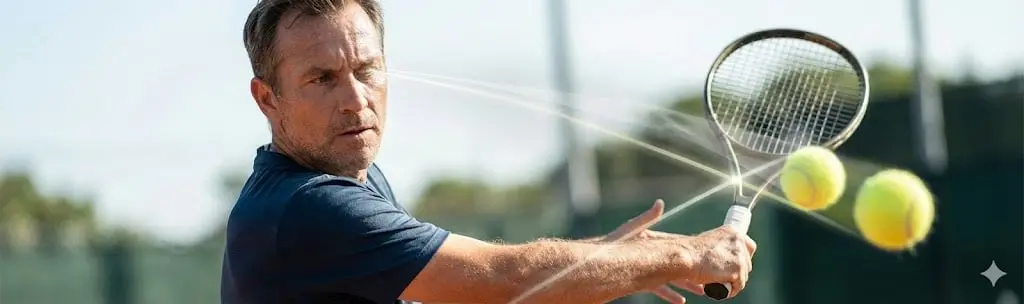
At some point, usually in your mid-40s, you notice it. The ball gets there a little faster than you expected. The print on your phone seems smaller than it used to be. Your reactions feel a half-step slow.
Some of this is physical. Muscles, joints, cardiovascular capacity all decline with age. But some of it is visual, and the visual changes follow their own timeline.
If you're an athlete past 40 who wants to keep competing, understanding what happens to your visual system as you age can help you adapt your training and know what's worth fighting to maintain.
What Actually Declines
Accommodation goes first for most people. This is your eye's ability to shift focus between near and far objects. The lens inside your eye becomes stiffer with age, making it harder to flex and change shape. Most people notice this in their early to mid-40s when they start holding their phone farther away to read it.
For athletes, reduced accommodation means slower focus shifts between near and far targets. If you're a tennis player tracking a ball that moves from the opposite baseline to right in front of you, the focus adjustment happens less quickly than it did at 25. Presbyopia (the clinical term for this age-related focusing decline) is universal. It happens to everyone.
Dynamic visual acuity (DVA) peaks surprisingly early and declines steadily after that. DVA is your ability to see detail in moving objects, and it's critical for almost every ball sport. A 2009 study at a sports performance facility found that DVA involving pursuit eye movements peaked in athletes aged 19-24 and declined with each older age group. Saccadic DVA (jumping your eyes to capture a moving target) peaked slightly later, around ages 22-27, but also declined with age. Yee et al., 2009, Journal of Vision
Static visual acuity (reading an eye chart) actually improved with age in this athlete population, probably because younger athletes were less likely to be wearing corrective lenses they needed. But DVA went down regardless.
Contrast sensitivity tends to decline with age. This is your ability to detect subtle differences between an object and its background. It matters most in low-light conditions or when the ball is moving against a complex background (like a baseball against a crowd of fans wearing white).
Peripheral vision narrows somewhat with age, though this varies considerably between individuals. Some research suggests that intensive sports practice may help preserve peripheral awareness in older athletes compared to sedentary adults.
Processing speed slows down. Even if your eyes gather the information accurately, your brain takes longer to make sense of it and initiate a response. This affects reaction time across the board.
What Stays Relatively Stable
Visual search strategies in experienced athletes remain effective even as other abilities decline. A study of handball athletes across age groups found that older skilled players showed similar fixation patterns (where they looked, how long they looked) compared to younger skilled players, even though their motor performance declined. The knowledge of where to look, built through decades of experience, persists.
Pattern recognition and anticipation may actually improve with age in experienced athletes. You've seen more situations, read more opponents, and built deeper mental models of what happens next. This can partially compensate for slower physical reactions.
Quiet Eye duration doesn't appear to decline substantially with age if you maintain practice. Older skilled performers can still produce the long, stable fixations that characterize expert aiming.
Sports Practice Appears to Slow the Decline
The most encouraging research involves martial artists. A 2015 study by Muiños and Ballesteros compared young and older judo and karate athletes to age-matched non-athletes on dynamic visual acuity tasks. Muiños & Ballesteros, 2015, Attention, Perception, & Psychophysics
Among young adults, karate athletes showed superior DVA compared to non-athletes. Among older adults, both judo and karate athletes showed better DVA than sedentary older adults. The gap between athletes and non-athletes was actually larger in the older groups.
The researchers concluded that sustained practice of a martial art attenuates the decline of dynamic visual acuity, suggesting neuroplasticity in the aging brain. Using your visual system intensively through sport may help preserve its function.
A review of physical exercise and perceptual skills in older adults reached similar conclusions. While DVA is one of the first abilities to decline with age, physically active individuals, especially those in fast-moving sports, tend to preserve it better than sedentary people. Muiños & Ballesteros, 2018, European Review of Aging and Physical Activity
This doesn't mean you can prevent all decline through training. Some deterioration is inevitable and biological. But the rate of decline appears to be modifiable.
Practical Implications
Given this research, here are some practical directions:
Keep playing. The "use it or lose it" principle applies to visual skills. Active sports participation seems to preserve visual function better than generic exercise or sedentary aging. Even if you have to dial back intensity or switch to a masters division, staying in the game matters.
Maintain focus flexibility training. Since accommodation declines universally, targeted exercises that challenge near-far focus shifts may help maintain whatever range you have. Near-far rock exercises (shifting focus between a close target and a distant one) are a standard approach.
Work on dynamic visual acuity. If DVA declines fastest, it may be worth specifically training it. Exercises that involve tracking moving targets or identifying details on objects in motion can challenge this skill.
Leverage experience. Your visual search strategies and pattern recognition aren't declining. Lean into them. You may not react as fast as you did at 25, but you can anticipate better. Watch more film. Study opponents. Make decisions earlier to compensate for slower execution.
Get your eyes checked regularly. Age brings higher risk for various eye conditions (cataracts, glaucoma, macular degeneration). Catching these early matters. Also, make sure your correction is optimized. Many masters athletes are squinting through outdated prescriptions.
Consider sport-specific eyewear. As contrast sensitivity declines, lens tints that enhance contrast for your particular sport conditions may help. Yellow or amber lenses can improve contrast in low light. Gray or brown lenses work better in bright conditions. Some shooters and golfers swear by specific tint combinations.
Train visual skills directly, not just sport skills. When you're younger, your visual system develops naturally through play and competition. As you age, you may need to be more deliberate about challenging visual abilities that are declining.
The Limits of What Training Can Do
Be realistic about what's possible. Training can slow decline and optimize remaining function. It cannot reverse fundamental biological changes. Your lens will still stiffen. Your processing speed will still slow. No amount of eye exercises will restore the visual system you had at 20.
What training can do is help you make the most of what you have. It can preserve abilities you'd otherwise lose faster. And it can help you adapt your playing style to compensate for what you can no longer change.
The athletes who compete successfully into their 40s, 50s, and beyond tend to be smart about adaptation. They play smarter, not just harder. They position better to reduce reaction demands. They read situations earlier. They train deliberately rather than assuming practice alone will maintain their skills.
Your eyes are going to age. But how much they decline, and how much that affects your performance, is at least partly in your control.
References
- Muiños M, Ballesteros S (2015). Sports can protect dynamic visual acuity from aging: A study with young and older judo and karate martial arts athletes. Attention, Perception, & Psychophysics. PubMed
- Muiños M, Ballesteros S (2018). Does physical exercise improve perceptual skills and visuospatial attention in older adults? A review. European Review of Aging and Physical Activity. Full Text
- Yee M et al. (2009). Static and dynamic visual acuities of athletes. Journal of Vision. Full Text
- Salthouse TA (1996). The processing-speed theory of adult age differences in cognition. Psychological Review. PubMed
This article is for educational purposes. Individual variation in aging is significant. Consult an eye care professional for personal assessment and recommendations.