Tennis Vision: Tracking the Ball at 130 MPH

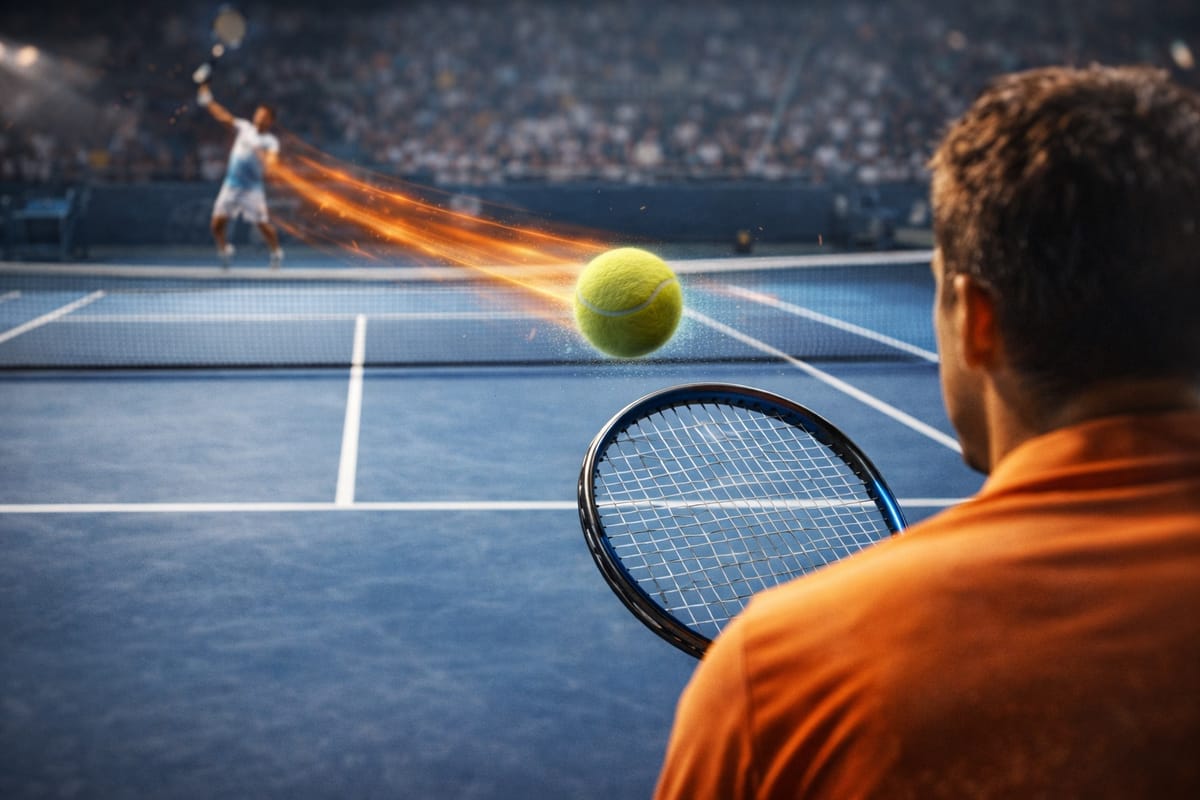
A professional tennis serve travels at 130 mph. The ball crosses the net in roughly 400 milliseconds. By the time the returner processes what they've seen and initiates their swing, more than half that time is gone.
How does anyone return serve? The answer reshapes how we think about vision in sports.
The Impossible Task
Here's the math that should make tennis unplayable.
- A 130 mph serve covers 58 meters per second. The ball travels approximately 23 meters from the server's racquet to the baseline. That's 400 milliseconds of flight time.
- Human visual reaction time—the gap between seeing something and initiating a motor response—runs 200-250 milliseconds for elite athletes. Add another 150-200 milliseconds to execute the swing.
This arithmetic doesn't work. The ball should be past you before your racquet starts moving.
Yet Roger Federer returned serves for 24 years at the highest level. Something else is happening.
Predictive Vision: Seeing the Future
Dr. Bruce Abernethy's landmark research at the University of Queensland transformed our understanding of expert perception in racquet sports (Abernethy & Russell, 1987). His methodology was elegant: show players video clips of opponents serving, but occlude different portions of the action. Sometimes players saw everything up to ball contact. Sometimes the video cut just before the racquet hit the ball.
The results split cleanly by skill level.
Expert players predicted serve direction accurately even when they never saw the ball leave the racquet. They read the server's body—the toss position, shoulder rotation, arm angle—and knew where the ball would go before it existed as a projectile.
Novice players needed to see actual ball flight. Their predictions without post-contact information dropped to chance levels.
This isn't mystical anticipation. It's learned pattern recognition running on years of accumulated data. The expert's visual system has encoded thousands of serving motions and their outcomes. They recognize the pattern before it completes.
More recent work by Williams and colleagues (Williams et al., 2002) used eye-tracking technology to map exactly where expert and novice players looked during return of serve. Experts fixated on the opponent's trunk and hitting arm earlier and longer than novices. They gathered relevant information while novices were still watching the ball toss.
The Eyes Tell Two Different Stories
Your visual system has two distinct tracking mechanisms, and tennis demands both.
- Smooth pursuit locks your gaze onto a moving target and follows it continuously. This is what you use when watching a bird fly across the sky. The system works well for predictable motion but maxes out at relatively slow angular velocities.
- Saccades are rapid jumps—ballistic eye movements that reposition your gaze faster than conscious control. You can't see clearly during a saccade. Your brain fills in the gap.
Tennis vision research by Land and McLeod (2000) showed something counterintuitive: expert batters in cricket (mechanically similar to tennis groundstrokes) don't smoothly track the ball through its entire flight. They can't—the ball moves too fast for continuous pursuit at certain phases.
Instead, elite players use a hybrid strategy. They pursue the ball smoothly off the opponent's racquet, then execute a predictive saccade to where they expect it to bounce. After the bounce, they re-acquire the ball with smooth pursuit through contact.
The key word is "predictive." The saccade jumps ahead of the ball to a point determined by early trajectory information. Get that prediction wrong and you're swinging at memory, not reality.
Hubbard and Seng (1954) established decades ago that baseball batters typically lose track of the ball in the final portion of its flight—the ball simply moves too fast relative to the head. The same appears true in tennis for high-speed shots. What separates experts isn't supernatural tracking ability. It's better prediction that reduces the visual uncertainty of those final milliseconds.
Net vs Baseline: Two Different Visual Problems
Playing at the net fundamentally changes the visual task.
At the baseline, you have time. A groundstroke traveling 60 mph from the opposite baseline gives you roughly 700 milliseconds. The ball's trajectory is mostly horizontal relative to your position, making left-right prediction easier than depth estimation.
At the net, you're dealing with 200-300 milliseconds of flight time. And the most critical information is depth—how far past you will this ball travel? Should you volley high or low? Take it on the forehand or backhand?
Stereopsis—the depth perception derived from having two eyes with slightly different viewpoints—operates most effectively at close distances. Beyond about 20 feet, the angular difference between what each eye sees becomes too small to provide useful depth information.
This actually helps net players. You're close enough for binocular depth cues to contribute meaningfully. But it also raises the stakes on quick, accurate vergence (the coordinated inward or outward rotation of the eyes to fixate on targets at different depths).
Research on volleyball players by Poltavski and Biberdorf (2015) found that depth perception accuracy correlated with blocking performance at the net—a task requiring rapid estimation of ball trajectory in three dimensions. Tennis volleying likely demands similar stereoscopic processing under time pressure.
Doubles: The Peripheral Battlefield
Singles tennis is largely foveal—you're fixating on the ball and your single opponent. Doubles demands peripheral vision.
You need to track the ball while monitoring four players across a 27-foot-wide court. Your partner's position. Both opponents. The alley. All while maintaining focus on a rapidly moving target.
Peripheral vision processes motion effectively but sacrifices resolution. You can detect that your partner is moving toward the net, but you can't read their facial expression. This trade-off matters tactically. Successful doubles teams develop shared mental models that reduce communication to simple motion cues detectable in peripheral vision.
Williams and Davids (1998) showed that expert field hockey players demonstrated superior peripheral awareness compared to novices when tracking multiple moving players. The same advantage likely applies in doubles tennis, though sport-specific research is less abundant.
The practical implication: training peripheral awareness may yield doubles-specific benefits separate from the foveal demands of ball tracking.
What We Actually Know About Training
Here's where honesty matters.
The research on visual training transfer to sport performance is encouraging but not definitive. Studies show that visual skills can be improved through training. The question is whether those improvements make you a better tennis player.
Appelbaum and Erickson (2016) reviewed the sports vision training literature and found mixed evidence. Some studies showed performance transfer. Others showed skill improvement on training tasks without corresponding game performance gains.
The clearest evidence supports training that closely resembles actual sport demands. General "vision training" divorced from tennis-specific context may improve your scores on vision tests without helping your return of serve.
What seems to help:
Perceptual training with sport-specific video. Watching serves and predicting outcomes—essentially simulating the pattern recognition experts develop through experience—shows some transfer to actual anticipation skills (Williams et al., 2002).
Quiet eye training. Vickers' research on the "quiet eye" phenomenon (Vickers, 1996) shows that expert performers maintain a final fixation longer before initiating action. Training this focused attention pattern has shown benefits across multiple sports.
Depth perception under time pressure. If you play net frequently, training quick depth judgments at short distances may be relevant. The visual system adapts to demands placed on it.
What remains uncertain:
General vision training (eye exercises, basic tracking drills) has weak evidence for sport transfer. Your visual hardware likely isn't the limiting factor. How you deploy attention and interpret patterns probably matters more.
Training anticipatory cues by watching video may help, but on-court practice against varied opponents probably helps more. The richest training environment is actual play against different styles.
The Aging Question
Visual function declines with age. Contrast sensitivity drops. Processing speed slows. For recreational players in their 40s, 50s, and beyond, this raises practical questions.
The encouraging news: anticipatory skills may remain relatively preserved even as raw visual processing declines. Abernethy and colleagues (Abernethy et al., 1994) found that expert performers maintained their pattern recognition advantages into older age, even when their basic visual function had declined.
Experience partially compensates for hardware degradation. You predict better because you've seen more, even if you see slightly worse.
This doesn't mean vision training is irrelevant for older players. Maintaining depth perception, peripheral awareness, and tracking speed through training may slow decline or preserve function. But the biggest gains likely come from accumulated pattern recognition—which simply requires playing against varied opponents and paying attention.
Practical Applications
If you want to improve your visual performance in tennis:
Play against different servers. Your anticipatory system learns from varied data. Playing only against similar opponents limits your pattern library.
Watch professional matches with purpose. Try predicting serve direction before the ball is struck. You're building the same anticipatory database that underlies expert prediction.
Train depth perception if you play net. Quick judgments of ball trajectory in three dimensions matter at the net. Any training that demands rapid depth estimation under time pressure may transfer.
Work on peripheral awareness for doubles. Practice maintaining ball focus while detecting partner and opponent movement. This attentional skill improves with deliberate practice.
Accept the limits. You're probably not going to develop significantly faster eye movements through training. But you can learn to use your existing visual system more effectively by knowing where to look and when.
The Real Takeaway
Tennis vision isn't about seeing faster. Human visual processing speed is relatively fixed. Elite players don't have superhuman eyes.
They have superhuman predictions.
Years of watching tennis balls leave racquets at every angle and speed builds an internal model of what comes next. That model runs automatically, below conscious awareness, generating predictions that let the body start moving before the ball is halfway to the net.
Training can accelerate this process. But there's no substitute for high-quality repetition against varied opponents. The visual system learns from experience. Give it good data and it will figure out tennis.
References
- Abernethy, B., & Russell, D. G. (1987). The relationship between expertise and visual search strategy in a racquet sport. Human Movement Science, 6, 283-319. https://doi.org/10.1016/0167-9457(87)90001-7
- Abernethy, B., Neal, R. J., & Koning, P. (1994). Visual-perceptual and cognitive differences between expert, intermediate, and novice snooker players. Applied Cognitive Psychology, 8(3), 185-211. https://doi.org/10.1002/acp.2350080302
- Appelbaum, L. G., & Erickson, G. (2016). Sports vision training: A review of the state-of-the-art in digital training techniques. International Review of Sport and Exercise Psychology, 11(1), 160-189. https://doi.org/10.1080/1750984X.2016.1266376
- Hubbard, A. W., & Seng, C. N. (1954). Visual movements of batters. Research Quarterly, 25(1), 42-57. https://doi.org/10.1080/10671188.1954.10624942
- Land, M. F., & McLeod, P. (2000). From eye movements to actions: How batsmen hit the ball. Nature Neuroscience, 3(12), 1340-1345. https://doi.org/10.1038/81887
- Poltavski, D., & Biberdorf, D. (2015). The role of visual perception measures used in sports vision programmes in predicting actual game performance in Division I collegiate hockey players. Journal of Sports Sciences, 33(6), 597-608. https://doi.org/10.1080/02640414.2014.951952
- Vickers, J. N. (1996). Visual control when aiming at a far target. Journal of Experimental Psychology: Human Perception and Performance, 22(2), 342-354. https://doi.org/10.1037/0096-1523.22.2.342
- Williams, A. M., & Davids, K. (1998). Visual search strategy, selective attention, and expertise in soccer. Research Quarterly for Exercise and Sport, 69(2), 111-128. https://doi.org/10.1080/02701367.1998.10607677
- Williams, A. M., Ward, P., Knowles, J. M., & Smeeton, N. J. (2002). Anticipation skill in a real-world task: Measurement, training, and transfer in tennis. Journal of Experimental Psychology: Applied, 8(4), 259-270. https://doi.org/10.1037/1076-898X.8.4.259