Sports Focus: Clay Target Sports (Part 2 of 2)
In Part 1, we covered the visual skills that matter for clay shooting: tracking, peripheral awareness, depth perception, focus flexibility, and reaction time.
But what does the science actually show about how elite shooters use their eyes? A series of studies led by Joe Causer and colleagues provides the most detailed picture we have. The findings confirm some intuitions, challenge others, and point toward specific, trainable skills that separate the best from the rest.
The Landmark Study
In 2010, researchers published the first systematic comparison of eye movements and gun motion between elite and sub-elite shotgun shooters. They studied 48 participants, 24 elite (national and international competitors) and 24 sub-elite (club-level) - across trap, skeet, and double trap at an ISSF shooting range under Olympic rules.
Using head-mounted eye trackers and external cameras capturing gun barrel kinematics, they measured what these shooters actually did during live fire. The results were clear and consistent.
The Quiet Eye Difference
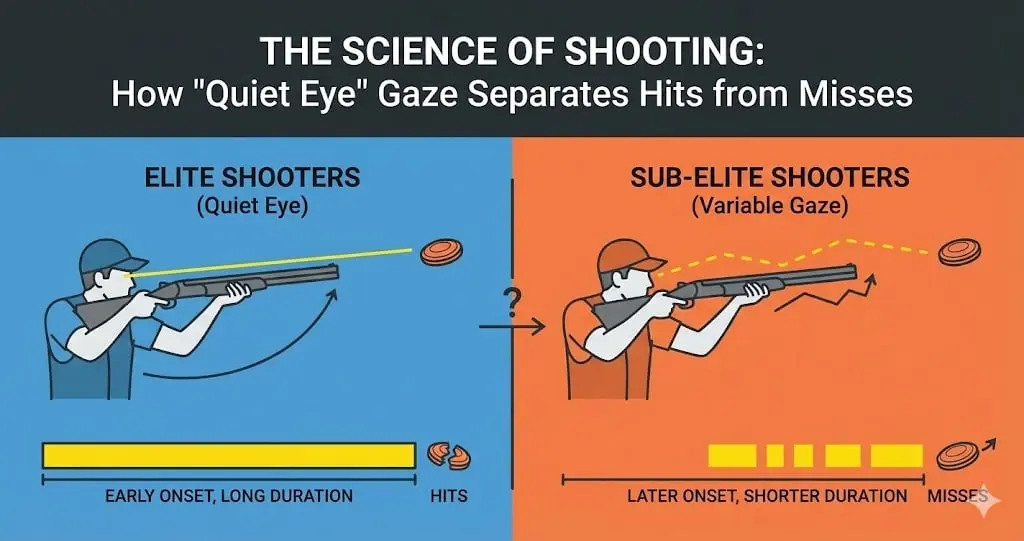
The most significant finding involved a gaze pattern called the Quiet Eye—the final sustained fixation or tracking gaze on the target before and during movement execution. In shotgun shooting, this means the last continuous lock on the clay before pulling the trigger.
Two patterns emerged:
Elite shooters achieved Quiet Eye onset earlier. They locked onto the target and established stable tracking sooner after target launch than sub-elite shooters. This earlier acquisition gave them more total time in the critical gaze-lock phase.
Elite shooters maintained Quiet Eye longer. Once locked on, they sustained that stable tracking gaze for a greater percentage of the shot sequence. The gaze didn't waver or break prematurely.
These differences held across all three disciplines. Whether shooting trap (with its unpredictable angles), skeet (with its crossing targets and doubles), or double trap (combining elements of both), elite shooters consistently demonstrated earlier onset and longer duration of Quiet Eye.
Hits vs. Misses: The Same Pattern
The researchers also compared gaze patterns on successful versus unsuccessful shots within each skill level. The findings reinforced the Quiet Eye hypothesis.
For both elite and sub-elite shooters, successful shots featured longer Quiet Eye durations and earlier onset compared to misses. When the Quiet Eye was shorter or started later, accuracy suffered—regardless of overall skill level.
This is important because it suggests the Quiet Eye isn't just something elite shooters happen to have. It's a functional component of the shot that affects outcome even for less skilled shooters. Get your gaze control right, and accuracy improves. Let it break down, and accuracy suffers.
Gun Motion: Slower Is Better
The eye tracking data told only part of the story. Gun barrel kinematics revealed another clear elite-vs-sub-elite difference: elite shooters moved their guns more slowly and smoothly.
Sub-elite shooters showed faster peak velocities and more erratic acceleration profiles. Their barrel paths were less controlled. Elite shooters, by contrast, demonstrated slower, steadier swings with smoother velocity curves.
This connects directly to the visual data. Jerky gun motion disrupts the visual-motor connection. If your gun is accelerating unpredictably, your eyes struggle to maintain stable tracking. The eye-gun system works best when both components move smoothly in coordination.
The slower swing also challenges a common amateur instinct: the urge to rush. Many recreational shooters speed up when they're struggling, chasing the target faster. The elite pattern suggests the opposite approach - smooth, controlled, deliberate motion produces better results.
What Happens Under Pressure
A follow-up study tested what happens to these patterns under competitive anxiety. Sixteen elite shooters performed under both practice conditions (low anxiety) and competition conditions (high anxiety).
Under high anxiety, shooters showed:
- Shorter Quiet Eye durations
- Less efficient gun motion (more variability in barrel movement)
- Decreased performance (fewer successful shots)
Anxiety didn't just affect mental state—it measurably disrupted the visual attention and motor control patterns that underlie accurate shooting. The stable gaze that elite shooters normally maintain broke down under pressure.
This has practical implications. If you've ever wondered why your shooting deteriorates in competition, the answer may be in your eyes. Stress shortens and destabilizes the very gaze patterns that produce good shots. Learning to maintain Quiet Eye under pressure may be as important as developing it in the first place.
Can You Train This?
The Causer research team followed up with a training intervention. They took 20 international-level skeet shooters and divided them into two groups. Both received video feedback of their shooting performance. But one group also received feedback on their gaze patterns - specifically, their own Quiet Eye duration compared to an expert model - along with a four-step pre-shot routine designed to enhance gaze control.
The results: the group receiving Quiet Eye training improved their shooting accuracy more than the control group. They also developed more efficient gaze patterns.
This matters because it demonstrates that visual behavior in shotgun shooting isn't purely innate. Expert gaze patterns can be trained. The same research team has shown similar results in other sports - putting, surgical skills, police shooting - suggesting the Quiet Eye is a trainable phenomenon across visuomotor tasks.
Applying This to Your Shooting
Based on the research, here's what appears to matter for visual performance in clay shooting:
Get on the target faster. Elite shooters achieve Quiet Eye onset earlier. This means picking up the clay and establishing smooth tracking as quickly as possible from your hold point. Don't let the target pull away while you're still acquiring it. Every millisecond of delay shortens your total Quiet Eye duration.
Maintain that lock. Once you've established tracking, don't let it break. Keep your eyes glued to the clay through trigger pull. The research shows that even among elite shooters, accuracy drops when Quiet Eye duration shortens. Your gaze should feel welded to the target.
Smooth your swing. Fast, jerky gun motion correlates with worse performance. Elite shooters move more slowly and smoothly. Match your gun speed to the target speed rather than trying to catch up or race ahead. Controlled motion supports stable visual tracking.
Practice under stress. If anxiety disrupts gaze control, then learning to maintain visual attention under pressure is a skill worth developing. Practice with stakes - a shooting partner who's counting, a timed drill, whatever creates some arousal - and pay attention to whether your visual patterns change.
Train your eyes off the range. The visual skills underlying shotgun performance—smooth pursuit tracking, quick saccades, sustained attention—can be developed through targeted exercises. While nothing replaces live fire, visual training can build the underlying capabilities that make good gaze control possible.
Discipline-Specific Considerations
While the core Quiet Eye pattern held across trap, skeet, and double trap, the visual demands differ somewhat by discipline:
Trap emphasizes quick acquisition and tracking on receding targets. You don't know which direction the clay will fly, so peripheral detection and rapid saccade-to-pursuit transitions matter. The target moves away from you, so your eyes must lock on quickly before it shrinks too much.
Skeet involves more crossing targets at higher angular velocities. Sustained smooth pursuit is paramount. On doubles, you need fast attention switching—maintaining awareness of the second target while executing on the first. The gaze patterns here involve more complexity.
Double trap combines elements of both—unpredictable launch angles with the need to sequence two targets quickly. The visual workload is high.
In all disciplines, though, the fundamental Quiet Eye relationship holds: earlier onset and longer duration predict better performance.
The Bigger Picture
What makes this research valuable is its specificity. "Focus on the target" is advice everyone gives. But the research shows what "focus" actually means at a measurable level - a sustained tracking gaze that begins early and extends through shot execution, supported by smooth gun motion and maintained even under pressure.
Elite shotgun shooters aren't just reacting faster or seeing better in some vague sense. They're implementing a particular pattern of visual behavior that can be observed, measured, and trained.
The gun is the tool. The shot follows the gaze. Train accordingly.
Research References
- Causer J, Bennett SJ, Holmes PS, Janelle CM, Williams AM (2010). Quiet Eye duration and gun motion in elite shotgun shooting. Medicine & Science in Sports & Exercise. PubMed
- Causer J, Holmes PS, Smith NC, Williams AM (2011). Anxiety, movement kinematics, and visual attention in elite-level performers. Emotion. PubMed
- Causer J, Holmes PS, Williams AM (2011). Quiet Eye training in a visuomotor control task. Medicine & Science in Sports & Exercise. PubMed
- Vickers JN (2007). Perception, Cognition, and Decision Training: The Quiet Eye in Action. Human Kinetics.
Visual training exercises are designed to challenge and develop eye movement skills. They are not medical treatment. If you have concerns about your vision or eye health, see a qualified eye care professional.