Sports Focus: Clay Target Sports (Part 1 of 2)

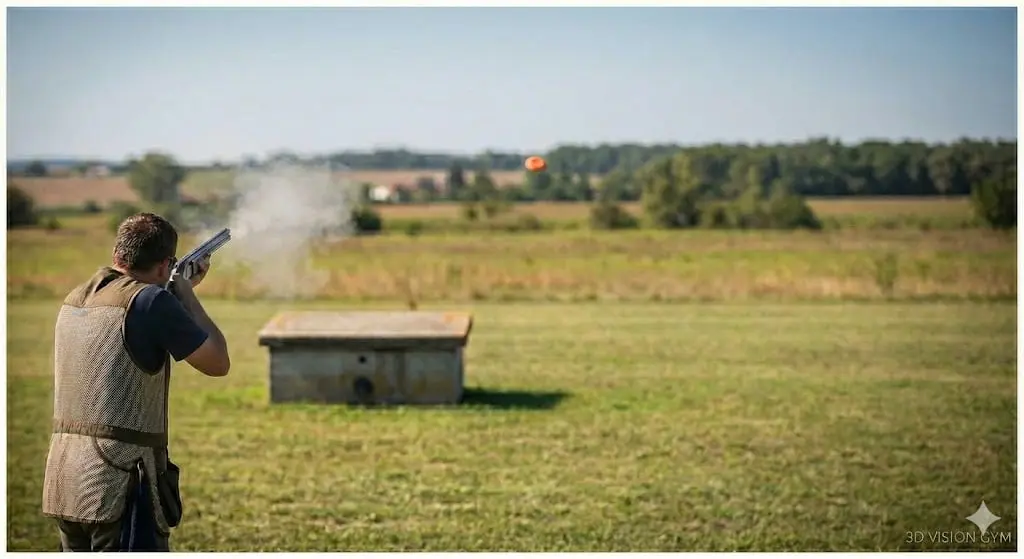
Breaking Clays: The visual skills that up-level scores
You stand at station three on a skeet field. The target emerges from the high house at your left, screaming across the sky at nearly 50 mph. Your eyes lock on, track its arc, intuitively feel the lead, and your finger squeezes the trigger. The clay explodes into dust.
Or it doesn't. And the difference can have nothing to do with your shotgun, your stance, or your follow-through.
Clay target shooters spend thousands on guns, chokes, and ammunition. They practice mount mechanics and swing technique. But a smaller number also train the system that matters most: their eyes. In a sport where you cannot hit what you cannot see, that's leaving points off your scorecard.
Whether you shoot trap, skeet, or sporting clays, your visual system processes enormous amounts of information in fractions of a second. The good news? Those visual skills are trainable. Here's what you need to know.
Trap vs. Skeet: Two Different Visual Challenges
At first glance, trap and skeet seem similar—point a shotgun at a flying disc and break it. But the visual demands differ substantially.
Trap Shooting: The Unpredictable Launch
In trap, you stand at one of five stations arranged in an arc, 16 yards behind the trap house. When you call for the target, a clay launches at 42-45 mph—but you don't know which direction. The oscillating trap machine throws targets across a 22-degree range: hard left, hard right, or anything in between. Disciplines such as Continental, Universal Trench, or Olympic/Bunker Trap increase the speed and angles further.
Your break point is typically 30-35+ yards out, giving you roughly 1.5 seconds from launch to shot. That sounds like plenty of time until you factor in what your visual system must accomplish:
- Detect the target as it emerges from the house (peripheral awareness)
- Acquire and lock on with both eyes (saccadic eye movement)
- Track the target as it moves away at 15-25 degrees per second (smooth pursuit)
- Judge distance for lead calculation, typically 2-6 feet depending on angle (depth perception)
- Maintain focus on the clay while your shotgun enters peripheral vision (focus flexibility)
Elite trap shooters complete the detection-to-acquisition phase in under 200 milliseconds. Average recreational shooters take 250 milliseconds or more. That 50-millisecond gap represents roughly 3-4 feet of target travel—often the difference between a center hit and a chip or miss.
Skeet Shooting: Bigger crossers and close in work
Skeet presents a different visual problem. Two houses—high (10 feet) and low (3.5 feet)—throw targets on fixed trajectories. You know exactly where the clay is coming from. The catch? Those targets move with more variation depending on where you’re standing, and crossing shots demand tight visual tracking coupled with pointing ahead of what you’re looking at.
Skeet targets launch at 47-50 mph. At stations 3, 4, or 5, the target crosses your field of vision at angular velocities exceeding 50 degrees per second—roughly double the tracking speed required for most trap shots.
Then there are doubles. When both houses throw simultaneously, your visual system must track two targets moving in opposite directions, prioritize one, break it, shift focus, reacquire the second target, and execute—all within about two seconds.
The skill breakdown shifts accordingly:
- Smooth pursuit tracking becomes paramount for crossing shots
- Peripheral awareness helps detect the second target while focused on the first
- Focus flexibility matters when shifting between targets at different distances
- Predictive tracking replaces the reactive tracking needed in trap
Both disciplines demand excellent depth perception. But trap emphasizes reaction time and target acquisition, while skeet prioritizes sustained tracking at high angular velocities and rapid focus shifts during doubles.

Visual Skills That Win Competitions
These are the specific visual capabilities that directly translate to broken clays.
1. Smooth Pursuit Tracking
When your eyes follow a moving target, they operate in one of two modes: saccades (quick jumps from point to point) or smooth pursuit (continuous fluid motion). You want smooth pursuit. Saccadic interruptions create momentary gaps in visual information—exactly when you need unbroken data about the target's trajectory.
Elite shooters maintain smooth pursuit on targets moving 15-50 degrees per second without their eyes "slipping" off and requiring corrective jumps. This isn't natural for everyone. Untrained eyes frequently lose tracking at higher speeds and compensate with saccades that introduce tiny delays and prediction errors.
The fix: tracking exercises that progressively increase speed and add unpredictable direction changes. Your brain learns to predict motion more accurately, reducing the need for corrective movements.
2. Peripheral Awareness
In trap, the target can emerge anywhere within that 22-degree window. You can't stare directly at the trap house exit—you need soft focus that covers the entire launch zone. The moment the clay appears in your peripheral vision, your eyes must snap to it and lock on.
Peripheral awareness is equally critical in skeet doubles, where you must track one target while sensing exactly when the second enters your field of view.
Training peripheral detection teaches your visual system to process more information from the edges of your vision without requiring direct fixation. Shooters with strong peripheral skills seem to see everything at once.
3. Focus Flexibility (Accommodation)
Here's something most shooters don't realize: when you call for a target, your eyes are focused at one distance (often the trap house or an intermediate hold point). The instant the target launches, you need to shift focus to a clay moving away from you, constantly changing distance.
This focus shift requires your eyes to change their optical power by 2-4 diopters in under 500 milliseconds. Slow accommodation means the target stays blurry for crucial fractions of a second.
Focus flexibility exercises train your eyes to shift between near and far rapidly and accurately, reducing blur time when acquiring targets.
4. Depth Perception
Lead calculation is fundamentally a depth perception problem. You're not aiming at the target—you're pointing at space ahead of where you’re looking (at the target). To calculate that trajectory accurately, you want to use all the tools possible, including how far away the target is. Especially in sporting clays where target setters will purposefully create false visual cues to ratchet up complexity. Depth perception also helps you read the target's trajectory in three-dimensional space, not just across a flat plane.
Precise binocular depth perception—where both eyes work together to triangulate distance—can be refined through targeted training that challenges your eyes at increasingly subtle depth differentials. This isn’t taking a side on one-eyed vs. two-eyed shooters. There are real issues that make two eyed shooting not ideal for an individual. But if you’re go to shoot two-eyed, sharpening depth perception is a valuable dynamic vision training area.
5. Reaction Time
From the moment the clay emerges, the clock is running. How quickly you can acquire and lock your vision onto to track smoothly. the less time you spend picking up the clay clearly the better things are likely to turn out.
Visual reaction time is trainable. It involves both sensory processing speed (how quickly your eyes detect the target) and motor response (how quickly your tracking system engages). Both improve with specific practice.
How 3DVisionGym Training Applies
The visual skills that matter for clay shooting—tracking, peripheral awareness, depth perception, focus flexibility, reaction time—are exactly what 3DVisionGym trains.
Tracking exercises build smooth pursuit capabilities. You follow targets at progressively higher speeds and across unpredictable paths, training your eyes to maintain lock without saccadic interruption. Start at speeds comfortable for everyday motion, then push into the 30-50 degree-per-second range that crossing skeet targets demand.
Peripheral awareness drills force you to maintain central focus while detecting and responding to stimuli in your peripheral field. This directly mirrors the trap shooter's challenge of watching a zone while waiting for an unpredictable launch, or the skeet shooter tracking one target while watching for the second.
Vergence and depth perception training refine your binocular vision. Convergence exercises (tracking objects approaching you) and divergence exercises (tracking objects receding) train the eye coordination that underlies distance judgment. The more precisely you perceive depth, the more accurate your lead calculations become.
Focus flexibility drills—jumping between near and far focus points—build the accommodation speed that gets targets sharp faster. Every millisecond you spend with a blurry clay is a millisecond of lost tracking data.
The 3D aspect matters particularly for shooters. Clay targets exist in three-dimensional space, moving toward or away from you as well as across your field of view. Flat screen training misses this dimension. Anaglyph-based depth training challenges your binocular system in ways that transfer to judging real-world distances.
A typical training session runs 10-15 minutes—less time than cleaning your shotgun. The exercises adapt to your current skill level, progressively challenging you as you improve. Some shooters train daily; others train several times per week. Consistency matters more than duration.
Putting It Together
You might own a $3,000+ shotgun fitted to your dimensions with the perfect choke. You might have grooved your mount and swing through thousands of rounds. But if your visual system is the weak link- if your tracking slips, if you're slow to acquire targets, if your depth judgment is imprecise - then you still underinvested.
Shooters who dominate at the competitive level see targets better. Their eyes lock onto targets faster, track them smoother, and deliver more accurate spatial information to the brain for lead calculation. Dynamic vision exercises complement range time watching targets with the gun directly in front of your eyes.
Visual training isn't a magic bullet. It won't turn a novice into an Olympian. But if you're leaving visual performance on the table - you're handicapping yourself unnecessarily. The skills are trainable. The time investment is minimal. And unlike that next shotgun upgrade, this addresses a system that actually limits performance. ;-)
Your shotgun is ready. Make sure your eyes are too.
Visual training exercises are designed to challenge and develop eye movement skills. They are not medical treatment and do not replace professional eye care. If you have concerns about your vision or eye health, consult a qualified eye care professional.