Soccer Vision: Scanning, Anticipation, and Seeing the Pass Before It's Open

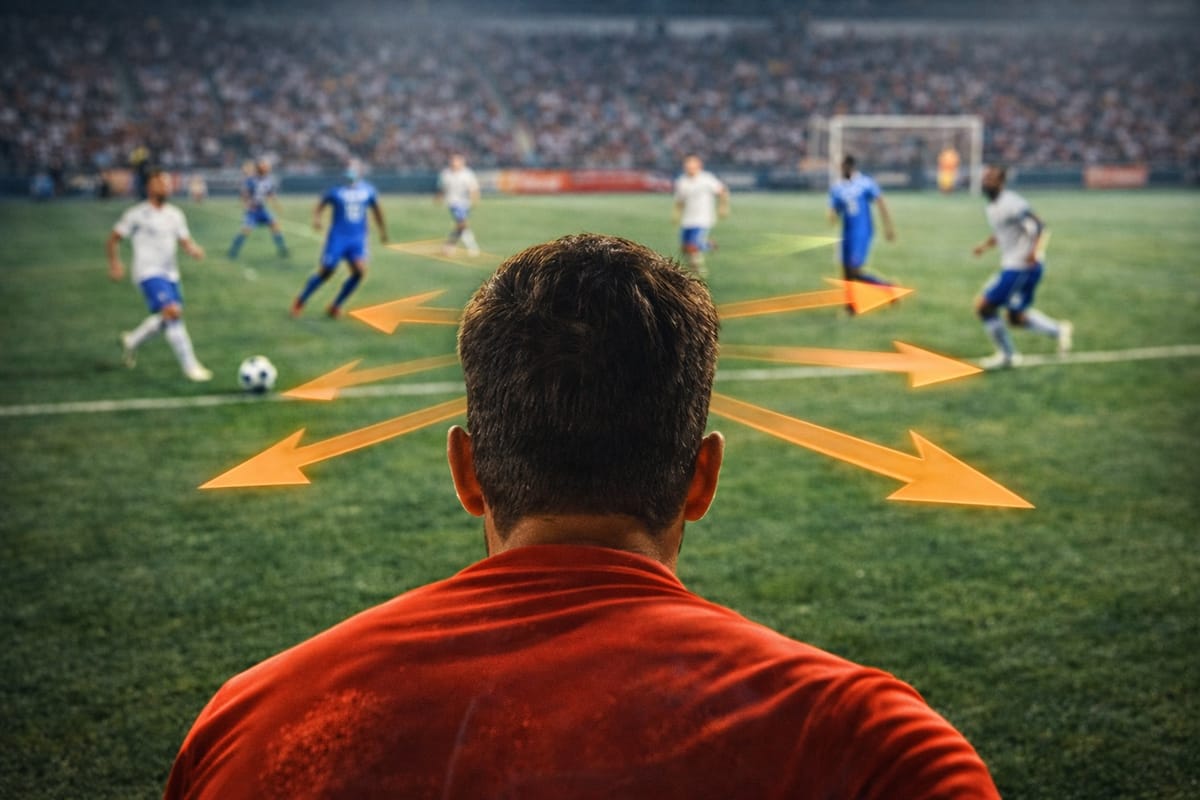
What separates elite midfielders from the rest isn't just technique. It's how they see.
The Xavi Problem
Watch footage of Xavi Hernandez in his prime. The ball arrives at his feet and within a touch—sometimes before the touch—he's already playing a pass that splits the defense. Opponents close him down, yet he never seems rushed. He operates in his own pocket of time.
Now watch a capable club-level midfielder receive the same ball in the same position. Head down, scanning for options, making a safe pass backward. The difference isn't foot speed or technical ability. Both players can execute a through ball. Only one saw it three seconds earlier.
Andrea Pirlo described it as "playing in slow motion." Others called it court vision, game intelligence, football IQ. These terms obscure more than they reveal. What Xavi, Pirlo, Iniesta, and their peers possessed was a trained visual system—specifically, an extraordinary ability to gather and process spatial information before and during ball reception.
This isn't mystical. It's measurable, and to a meaningful degree, it's trainable.
Geir Jordet and the Science of Scanning
Norwegian sports psychologist Geir Jordet has spent over two decades studying what elite soccer players actually do with their eyes. His research, beginning in the early 2000s and continuing through partnerships with clubs and national teams, provides the clearest picture we have of visual expertise in football.
Jordet's methodology was straightforward: video-record players in matches, count how often they turn their heads to scan the field, and correlate scanning frequency with subsequent performance.
The findings were stark.
In a 2005 study published in the Journal of Applied Sport Psychology, Jordet analyzed English Premier League midfielders and found that players who scanned more frequently before receiving the ball made significantly better decisions with it. The relationship was nearly linear—more scans, better passing accuracy, faster play, fewer turnovers.
Subsequent research refined this. Jordet found that elite players scanned 0.5 to 0.6 times per second in the moments before receiving possession—roughly one head turn every two seconds. Average professional players scanned significantly less, around 0.3 to 0.4 times per second. The gap between elite and good might sound small, but over the 10-15 seconds before receiving a pass, it translates to 2-3 additional visual snapshots of the field.
Those extra snapshots matter enormously. Each scan updates the player's mental model of where teammates and opponents are positioned and—critically—where they're heading. More data points mean better predictions.
Jordet's 2013 work with the Norwegian national team demonstrated something equally important: scanning behavior is trainable. After targeted interventions emphasizing pre-reception scanning, players measurably increased their scan rates and improved their in-game decision making.
What Scanning Actually Accomplishes
Turning your head to look around seems obvious. Why don't all players do it equally? The answer involves understanding what scanning costs and what it provides.
Each scan takes roughly 200-400 milliseconds. During that time, the player isn't watching the ball. In tight spaces with closing defenders, those fractions of seconds feel risky. The natural tendency—especially under pressure—is to keep eyes on the ball and deal with what's in front of you.
Elite players override this tendency. They've learned that brief periods of not watching the ball are worth the tradeoff because of what they gain: advance knowledge of the spaces that will open, the runs teammates are about to make, the gaps in defensive coverage.
This advance knowledge transforms the moment of ball reception. Instead of receiving and then deciding, the elite player receives having already decided. The ball arrives and immediately leaves because the processing happened seconds earlier.
The scan itself is only useful if the brain can integrate each snapshot into a coherent spatial model. This is where the visual system's sophistication matters. A player might scan frequently but retain nothing. Elite scanners capture position, velocity, and trajectory information from each glance and use it to extrapolate where everyone will be by the time they receive the pass.
Peripheral Vision: The Field Within the Field
Scanning addresses what happens when you move your gaze. Peripheral vision addresses what you can see without moving it.
The human visual field extends roughly 180-200 degrees horizontally, though only the central 2-3 degrees—the fovea—provide sharp detail. Everything outside that narrow cone is peripheral: lower resolution but still valuable for detecting motion and tracking multiple objects.
For soccer players, peripheral vision serves two functions.
First, it enables monitoring while fixated. When a midfielder focuses on a teammate making a diagonal run, peripheral vision detects the defender sliding to cover, the second runner peeling off, the goalkeeper shifting position. The player doesn't need to look at each element; peripheral processing handles them simultaneously.
Second, peripheral vision triggers scanning. Something flickers at the edge of awareness—a teammate starting a run, a defender cheating toward the ball—and the player turns to investigate with focused vision. Good peripheral awareness means noticing more triggers, which means more targeted scans, which means richer information.
Research on soccer players has shown that elite performers have wider effective peripheral fields than non-experts. This isn't necessarily about physiological differences—it's about trained attention. Experts have learned to extract useful information from peripheral regions that novices ignore.
Anticipation: Predicting the Future State of the Field
Vision provides data. Anticipation converts that data into prediction.
When Xavi played a through ball, he wasn't passing to where the striker was—he was passing to where the striker would be in 1.5 seconds. The same calculation applied to the defender, the goalkeeper, and the second runner creating a decoy. Multiple moving objects, multiple predicted trajectories, one decisive pass.
This predictive ability develops through pattern recognition. Thousands of hours of play and observation build a library of scenarios: how defenders shift when a ball goes wide, how midfielders compress space around a receiving player, how attacking runs typically develop. When a familiar pattern emerges, the brain matches it to stored examples and predicts the likely evolution.
Visual information quality limits prediction accuracy. A player with poor scanning and limited peripheral awareness sees a snapshot of current positions. A player with excellent visual habits sees position, velocity, and acceleration—the full dynamics of the situation. Better input, better prediction.
Research by Williams and colleagues at Liverpool John Moores University has documented this relationship. When shown video clips of developing plays and asked to predict outcomes, expert players significantly outperformed novices. The experts' advantage was greatest when clips were occluded (stopped) early, demonstrating that experts extract predictive information faster.
Goalkeeper Vision: A Different Mandate
Goalkeepers face visual demands that differ from outfield players in important ways.
The scanning pattern is compressed and intensified. Instead of tracking the full field, goalkeepers focus on the penalty area and its immediate surroundings. But within that zone, they process an enormous amount of information: multiple attackers, ball position, crossing trajectories, near-post and far-post vulnerabilities, set-piece positioning.
Research on penalty kicks—most notably by Mark Williams and colleagues—has shown that expert goalkeepers extract cues from the kicker's approach and body position to anticipate shot direction. The cues are subtle: hip orientation, plant foot angle, approach trajectory. Goalkeepers who identify these cues earlier move earlier and save more penalties.
Beyond penalties, goalkeepers must track the ball through visual clutter. Crosses into crowded boxes, shots through traffic, deflections—each requires maintaining focus on a moving object while bodies interfere with sight lines. This demands exceptional smooth pursuit tracking and the ability to reacquire a lost target quickly.
Depth perception matters more for goalkeepers than any other position. Judging whether a cross will reach the front post or sail to the back post, whether a shot is dipping under the bar or rising over it, whether to come out and claim or stay on the line—all depend on precise distance estimation.
Ball Tracking at Close Range
Most discussion of soccer vision emphasizes the off-ball aspects: scanning, anticipation, awareness. But there's also the moment of action itself—heading a cross, volleying a cutback, controlling a driven pass.
At these moments, visual demands shift to close-range tracking. A ball arriving for a header covers the final ten feet in roughly 200 milliseconds. The player must track it onto their forehead (or temple, or crown) while defenders compete for the same space and the body is often in motion.
Research on ball-heading has documented that players who maintain visual contact with the ball longer make cleaner contact. The temptation is to close the eyes before impact—an instinctive protective response. Elite headers override this, tracking the ball until the last possible moment.
Volleys and first-touch control present similar challenges. The ball arrives at speed, sometimes with spin, often on unpredictable trajectory. Visual tracking must continue while the body organizes a complex motor response.
This is vergence in action: the eyes converging to maintain binocular focus on a rapidly approaching object. Untrained players lose depth tracking when the ball enters close range. Trained players maintain it, which means cleaner contact and better control.
What Training Can and Cannot Do
The honest answer about visual training for soccer players is that the research is promising but not definitive. We know several things with reasonable confidence:
Scanning behavior is trainable. Jordet's work and subsequent interventions have demonstrated that players can increase scan frequency with deliberate practice and feedback. Whether through video review, verbal cues from coaches, or structured drills, players learn to scan more.
Anticipation improves with expertise. The pattern recognition that underlies prediction develops through playing and watching the game. There's no shortcut to the thousands of hours that build deep familiarity with how situations unfold.
Fundamental visual skills can be trained. Smooth pursuit tracking, vergence, peripheral awareness, depth perception—these underlying capacities improve with targeted exercise. The research base here comes from optometric sports vision studies and extends beyond soccer specifically.
What remains less certain is how much lab-based visual training transfers to field performance. A player who improves at tracking a moving target on a screen may or may not improve at tracking a ball through a crowded penalty box. The contexts are different. The ecological validity of training is an ongoing question.
The reasonable position is that visual training can strengthen foundational skills, but it's not a substitute for playing and practicing the sport itself. A midfielder who never develops the habit of scanning won't be saved by excellent smooth pursuit. But a midfielder who scans well and also has highly trained fundamental vision—that combination is powerful.
Practical Implications
For players looking to develop their visual game:
Scan deliberately. Jordet's research provides a clear prescription: look around more, especially in the seconds before receiving a pass. Build the habit in training until it becomes automatic in matches. Count your scans. Video yourself and count how often your head moves.
Practice with peripheral load. Training drills that require processing central and peripheral information simultaneously build the divided attention that soccer demands. Small-sided games with additional rules (call out a color, track a secondary ball) force broader awareness.
Train visual fundamentals. The tracking, vergence, and peripheral skills that underlie field vision respond to exercise. Consistent work on these basics may sharpen the raw material your visual system works with.
Watch the game intentionally. When observing matches, watch off-ball movement. Track how elite midfielders time their scans. Notice where they look before receiving. The pattern library that enables anticipation builds through observation as well as participation.
Accept the limits. Visual training is one component of development, not a shortcut to expertise. The midfielder who sees passes nobody else sees got there through years of playing, watching, and processing the game. Better vision supports that process; it doesn't replace it.
The Competitive Edge
Soccer is a sport of small margins. The through ball that arrives a fraction early or late. The header won by centimeters. The save made because the goalkeeper read the hips correctly.
Elite players look different partly because they see different—more, earlier, better. Their visual systems extract information that others miss and convert it into predictions that others can't make. This isn't magic. It's trainable expertise.
Developing that expertise requires understanding what the visual system actually does during play: scanning to build spatial models, using peripheral awareness to monitor while fixated, tracking the ball through close-range chaos, predicting where the game will be rather than where it is.
None of this replaces technique, tactical understanding, or physical conditioning. It complements them. The complete player integrates all these elements. And for too long, the visual element has been ignored.
Your legs aren't the only muscles you can train.
Visual training exercises are designed to challenge and develop eye movement skills relevant to athletic performance. They are not medical treatment and do not replace professional eye care. If you have concerns about your vision or eye health, consult a qualified eye care professional.
References:
- Jordet, G. (2005). Perceptual training in soccer: An imagery intervention study with elite players. Journal of Applied Sport Psychology, 17(2), 140-156. https://doi.org/10.1080/10413200590932452
- Jordet, G., Bloomfield, J., & Heijmerikx, J. (2013). The hidden foundation of field vision in English Premier League (EPL) soccer players. MIT Sloan Sports Analytics Conference.
- Williams, A.M., & Reilly, T. (2000). Talent identification and development in soccer. Journal of Sports Sciences, 18(9), 657-667. https://doi.org/10.1080/02640410050120041
- Williams, A.M., Davids, K., & Williams, J.G. (1999). Visual Perception and Action in Sport. E & FN Spon.
- Savelsbergh, G.J., Williams, A.M., Van der Kamp, J., & Zaal, F.T. (2002). Visual search, anticipation and expertise in soccer goalkeepers. Journal of Sports Sciences, 20(3), 279-287. https://doi.org/10.1080/026404102317284826