Seeing the Ball: What Vision Research Tells Us About Hitting

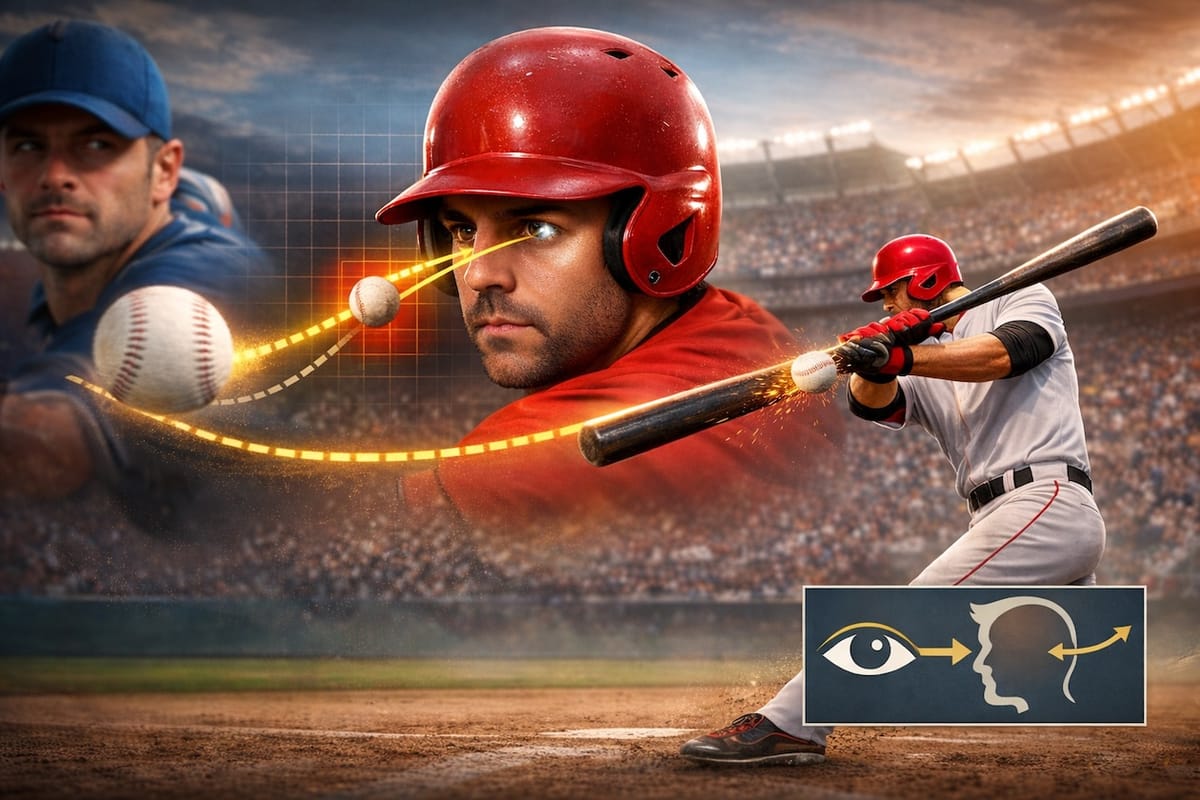
"Keep your eye on the ball."
It's the oldest advice in baseball. It's also impossible to follow literally. A 90 mph fastball travels from the pitcher's hand to home plate in about 400 milliseconds. During the last portion of its flight, the ball is moving across your visual field faster than your eyes can physically track. Nobody, not even the best hitters in the world, watches the ball hit the bat.
So how do great hitters manage to connect? Researchers have been studying this question for decades, and the answers are more interesting than the old coaching cliché suggests.
The Problem With "Keep Your Eye on the Ball"
The first study to examine this question was published in 1954 by Hubbard and Seng. They analyzed film of professional hitters and found that smooth pursuit eye movements (where your eyes follow a target continuously) don't continue all the way to the point of contact. The eyes lose the ball somewhere in the final stretch.
Thirty years later, Bahill and LaRitz confirmed this finding with better equipment. They tested a mix of college players and one MLB player (Brian Harper) and found the same basic pattern. Hitters track the ball for part of its flight, then lose it. Even a major league hitter can't follow a pitch with his eyes from release to contact.
What separates great hitters is that they seem to know where the ball is going anyway.
How Elite Hitters Track Pitches
A 2020 study by Kishita and colleagues at NTT Communication Science Laboratories in Japan got unusually close to the real thing. They tested six current professional baseball players from Japan's Nippon Professional Baseball league, having them face former professional pitchers throwing actual fastballs and curveballs. Eye movements were tracked with a wearable device while motion capture recorded head, bat, and ball positions. Kishita et al., Frontiers in Sports and Active Living
The findings challenged some assumptions.
First, all the batters used predictive saccades. Rather than trying to smoothly track the ball all the way, they jumped their eyes ahead to where they predicted the ball would arrive. Their gaze was often waiting at the predicted contact point before the ball got there.
Second, the best hitters in the group (three from top NPB teams versus three from farm teams) initiated their predictive saccades later than the less skilled hitters. This seems counterintuitive, but it makes sense: the better hitters spent slightly more time gathering visual information before committing to a prediction. They were more patient with their eyes.
Third, head movement played a major role. The better batters coupled head rotation closely to ball movement, keeping the ball in a consistent position relative to their head throughout the pitch. This may simplify the visual processing required.
A similar finding came from cricket research. Mann, Spratford, and Abernethy (2013) found that elite cricket batters used a strategy where they tracked the ball with coordinated head and eye movements early, then made a saccade to "park their gaze" at the anticipated bounce or contact point. Their eyes would be waiting there when the ball arrived. Mann et al., PLoS ONE
Two Strategies for Tracking
Researchers have identified two broad strategies hitters use:
The optimal hitting strategy involves tracking the ball for as long as possible with smooth pursuit, trying to maximize the visual information gathered about pitch trajectory. This gives you more time to recognize pitch type and judge location.
The optimal learning strategy involves making an earlier predictive saccade to where you think the ball will arrive. If your eyes aren't on the ball after the saccade, you know your prediction was wrong. This gives you feedback to adjust on subsequent pitches.
Both strategies appear in skilled hitters, sometimes within the same at-bat depending on the situation. When a hitter knows the pitch type in advance, the Kishita study found they initiate predictive saccades later, suggesting they use the extra certainty to gather more visual information. When the pitch type is unknown, hitters jump earlier.
Pre-Pitch Gaze: Where to Look Before the Ball Is Released
Vision in hitting doesn't start at ball release. Where you look before the pitch matters too.
Research by Kato and Fukuda (2002) found that skilled batters use consistent visual search strategies during the pitcher's windup. They tend to fixate on specific locations: the pitcher's throwing hand, the release point area, or the space between the pitcher and themselves. Less skilled batters show more variable patterns.
What should you look at? The research suggests focusing on the release point or the area where the ball will first become visible. Some hitters report fixating on the pitcher's cap logo or a spot above the release point to minimize the distance their eyes need to travel once the ball appears.
There's also evidence that pre-pitch saccades happen, even when hitters don't consciously notice them. Your eyes may be making small adjustments throughout the windup to optimize position for ball pickup.
Pitch Recognition: Seeing What's Coming
Elite hitters don't just see the ball. They see spin, seam orientation, and arm angle, then use those cues to predict what the pitch will do.
Studies using video occlusion (where the pitch video cuts off partway through) have found that skilled hitters can predict pitch type and location from very early cues, sometimes before the ball even leaves the pitcher's hand. They're reading the windup, arm slot, and release to anticipate what's coming.
This pitch recognition skill appears to be trainable. Occlusion training programs show hitters brief clips and ask them to predict the outcome. Some research shows improvements in recognition accuracy, though the transfer to actual batting performance is still being studied.
A 2011 study at the University of Cincinnati tested a vision training program with the baseball team that included near-far focus exercises, convergence training, and pitch recognition drills. The team showed improvements in several batting statistics over the season, though the study had limitations (no control group, multiple interventions combined).
What This Means for Training
A few practical directions from the research:
Train pitch recognition separately. If skilled hitters are making decisions before or just after release, then improving your ability to read early cues matters. Video-based pitch recognition training can build this skill.
Practice with intent about where you look. Have a plan for where your eyes will be during the windup and at release. Experiment with different anchor points and see what helps you pick up the ball earliest.
Don't worry about tracking all the way. The best hitters in the world don't do it. What matters is gathering enough information early to make an accurate prediction about where the ball will arrive.
Consider head movement. Some research suggests that coordinating head rotation with ball flight keeps the visual problem simpler. The coaching cue "keep your head still" may be less accurate than "let your head follow the ball."
Work on the fundamentals. Vergence (the ability to keep both eyes aimed at a target as it approaches), accommodation (focus flexibility), and saccade accuracy all contribute to visual performance. Basic oculomotor training can build these skills.
The Bottom Line
"Keep your eye on the ball" is an oversimplification. Great hitters do something more sophisticated: they track the ball early, gather information about trajectory and spin, make a prediction, then jump their eyes to where they expect to make contact. The ball arrives to find their gaze already waiting.
This involves trainable skills at every stage. Reading the pitcher, tracking early flight, predicting trajectory, and executing a well-timed saccade to the contact zone. None of these things happen by magic. They develop through thousands of repetitions, and they can be sharpened with deliberate practice.
The research is still evolving. We don't yet have definitive evidence that a particular eye movement pattern causes better hitting. But we know that elite hitters share certain visual strategies, and those strategies can be taught. Learn more about Baseball and 3DVisionGym.
References
- Kishita Y, Ueda H, Kashino M (2020). Eye and head movements of elite baseball players in real batting. Frontiers in Sports and Active Living. Full Text
- Mann DL, Spratford W, Abernethy B (2013). The head tracks and gaze predicts: How the world's best batters hit a ball. PLoS ONE. Full Text
- Higuchi T et al. (2018). Head-eye movement of collegiate baseball batters during fastball hitting. PLoS ONE. Full Text
- Bahill AT, LaRitz T (1984). Why can't batters keep their eyes on the ball. American Scientist 72(3): 249-253.
- Toole AJ, Fogt N (2021). Head and eye movements and gaze tracking in baseball batting. Optometry and Vision Science. PubMed
These observations are based on research findings and are intended for educational purposes. Consult qualified coaches and eye care professionals for personalized guidance.