Saccades: The Eye Movements Behind Every Play

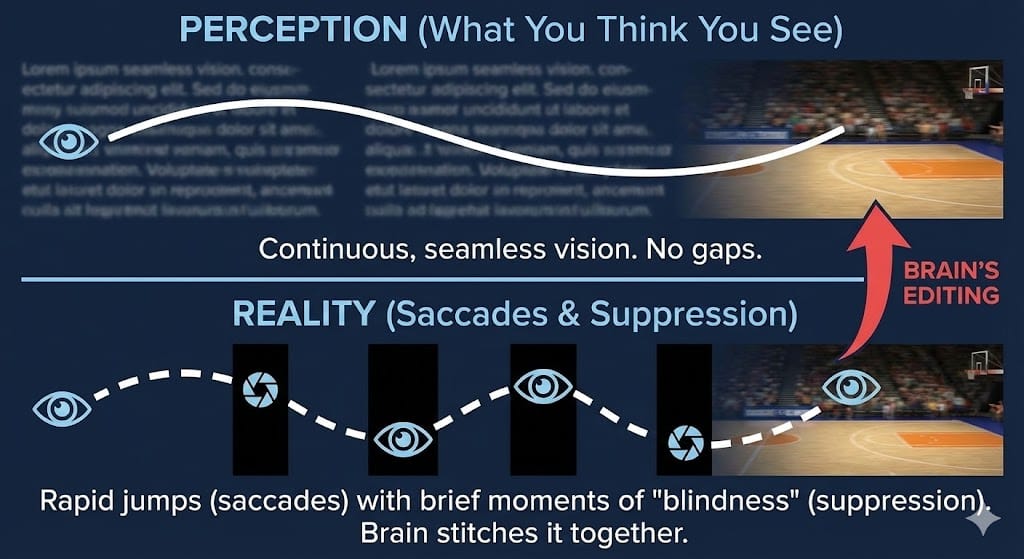
Right now, as you read this sentence, your eyes are jumping from word to word. You don't feel it happening because your brain hides the blur from you. But if someone filmed your eyes in slow motion, they'd see a series of quick hops with brief pauses between them.
Each hop is called a saccade.
Athletes make thousands of saccades during a game, and most have never heard the word. These rapid eye movements play a central role in how you scan a field, pick up a pitch, and react to an opponent.
How Saccades Work
Your eyes have two basic ways of tracking things. The first is smooth pursuit, where your eyes follow a moving target like a camera panning across a scene. This works reasonably well when things move slowly and predictably.
The second is saccades. When something moves too fast for smooth pursuit, or when you need to shift your gaze to a new location, your eyes make a rapid ballistic jump. These jumps are surprisingly fast, with peak velocities exceeding 500 degrees per second. The whole movement typically lasts less than a tenth of a second.
During a saccade, your vision essentially shuts off. Your brain suppresses the visual input so you don't experience a disorienting blur as your eyes whip across the scene. Scientists call this saccadic suppression. You only actually "see" during the fixation pauses between saccades. Your brain stitches these snapshots together into what feels like continuous vision.
This matters for sports because you're not seeing everything you think you're seeing. There are gaps. And the efficiency of your saccadic system determines how well you cover those gaps.
Saccades in Competition
A volleyball player scanning the court before a serve makes a series of saccades to check where the defenders are standing. A basketball point guard uses saccades to survey passing options while dribbling. A batter's eyes jump from the pitcher's release point toward the incoming pitch.
Research on expert athletes shows some consistent patterns. Skilled performers tend to make fewer saccades than beginners, but their fixations land on more relevant locations and last longer. They extract more useful information from each look.
A 2010 study on volleyball players found that experts made fewer fixations of longer duration compared to novices watching the same game footage. The experts also looked at different things. While novices watched the ball travel through the air, experts focused on the setter's hands and body position to predict where the ball would go next. Piras et al., Journal of Sports Medicine and Physical Fitness
In baseball, the challenge is even more extreme. A 90 mph fastball reaches home plate in about 400 milliseconds. The ball's angular velocity exceeds what smooth pursuit can handle during the final portion of its flight. Research by Mann and colleagues on elite cricket batters found they use predictive saccades, jumping their eyes ahead to where they expect the ball to arrive. They don't try to track the ball all the way. Instead, they gather information early, predict the trajectory, then move their eyes to "lie in wait" at the predicted contact point. Mann et al., 2013, PLoS ONE
In fast-ball sports, training your saccades to land accurately on predictive locations may matter more than trying to improve raw tracking speed.
What the Research Shows
Several studies have compared saccadic performance between athletes and non-athletes. The findings depend a lot on what gets measured and which sport is being examined.
A 2007 study found that female volleyball players showed better saccadic eye movement performance and faster accommodation (focus shifting) than non-players. Advanced players outperformed beginners. Vera et al., PubMed A 2024 study on table tennis players found they made more accurate saccades when tracking moving targets, likely because they'd spent years practicing exactly that skill. Nakazato et al., Frontiers in Sports and Active Living
However, some research finds no difference in basic saccade metrics (like latency or velocity) between athletes and non-athletes when measured in laboratory conditions with simple stimuli. The advantage seems to emerge most clearly when the task resembles what athletes actually do in their sport.
Saccadic skill appears to be somewhat task-specific. Getting faster at generic eye-movement drills doesn't automatically transfer to improved performance on the field. The most effective training probably involves sport-relevant stimuli and decision-making.
How to Train Saccades
Saccade training comes in two main flavors.
The first is basic oculomotor training, where you practice jumping your eyes between fixed targets. These drills can improve the speed and accuracy of saccadic movements themselves. You might use a saccade chart (a sheet with letters or numbers scattered at various positions) and practice jumping from target to target as quickly as possible while calling out what you see. The goal is fast, accurate jumps with minimal overshoot or undershoot.
The second is sport-specific visual search training. Here, you practice making saccades in contexts that mimic your sport's demands. For a soccer goalkeeper, this might mean watching video clips of penalty kicks and training yourself to look at the shooter's hips and plant foot rather than the ball. For a baseball hitter, it might mean occlusion training where you see only the first portion of a pitch and must predict its location.
Both approaches have value. Basic drills build the foundational eye movement skills. Sport-specific training teaches you where to look and when.
A few practical approaches:
Saccade charts. Print a chart with letters arranged randomly across the page. Practice jumping from letter to letter as fast as you can while maintaining accuracy. Time yourself and track improvement over weeks.
Near-far jumps. Hold a target (like a pen) at arm's length and place another target across the room. Jump your focus back and forth as quickly as possible while keeping each target clear. This trains saccades combined with accommodation (focus changes). Or for a more complicated training use a small version of a saccade chart and a far one. Read across a line alternating near and far. Here’s a free version to get you started.
Sport video analysis. Watch footage of your sport and consciously notice where your eyes go. Are you looking at the most informative locations? Try to train yourself to prioritize the cues that experts use.
Peripheral reaction drills. Have a partner hold up fingers or flash cards in your peripheral vision. When they signal, make a saccade to that location and identify what you see. This trains quick, accurate jumps triggered by peripheral detection.
The Takeaway
Saccades are the rapid eye jumps that let you scan your environment and shift focus between objects. They happen automatically, but they can be trained. Athletes with efficient saccadic systems gather visual information faster and from more useful locations.
The research suggests that expert-novice differences in saccades show up most clearly in sport-specific tasks. Basic eye movement drills can build foundational skills, but the real gains probably come from training your eyes to look at the right things at the right times in contexts that match your sport.
Your eyes are making thousands of these jumps every game. Might be worth knowing what they're doing.
References
- Piras A, Lobietti R, Squatrito S (2010). A study of saccadic eye movement dynamics in volleyball. J Sports Med Phys Fitness. PubMed
- Mann DL, Spratford W, Abernethy B (2013). The head tracks and gaze predicts: How the world's best batters hit a ball. PLoS ONE. Full Text
- Nakazato R et al. (2024). Table tennis players use superior saccadic eye movements to track moving visual targets. Frontiers in Sports and Active Living. Full Text
- Vera J et al. (2007). Comparison of saccadic eye movements and facility of ocular accommodation in female volleyball players and non-players. PubMed. Link
These exercises are designed to challenge visual skills. They are not medical treatment. If you have concerns about your vision or eye health, consult a qualified eye care professional.