New tool: Response timer for training fusion speed


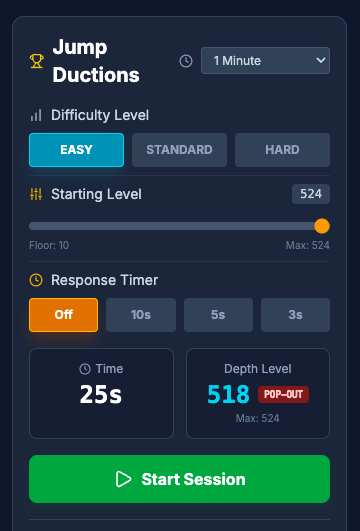
There's a difference between being able to fuse a stereoscopic image and being able to fuse it under time pressure. If you've been training vergence exercises in Open Gym, you've probably noticed that at comfortable levels, you can pick out the target circle almost instantly. At harder levels, you need a beat—sometimes a long one - to let the depth pop. That pause is your vergence latency, and in competition, it's a luxury you don't have.
We added a Response Timer to Open Gym's vergence exercises. It's simple: set a time limit per trial (10, 5, or 3 seconds), and if you don't respond before it expires, the trial counts as a miss. Your level drops, back-off kicks in, and the next trial appears. No visible countdown on screen - just a silent clock holding you honest.
Why Fusion Speed Matters
A 130 mph tennis serve crosses the court in about 400 milliseconds. Subtract 200-250ms for basic motor reaction time, and you're left with roughly 150ms to read the ball and commit to a swing. At the net, where stereopsis actually works (binocular depth cues are most useful within 20 feet), that window shrinks further. Visual range counts, but only if you can achieve fusion fast enough to use it.
Soccer presents a similar bottleneck from a different angle. A ball arriving for a header covers its final 10 feet in around 200ms. Players who lose vergence tracking in close range—and untrained players reliably do—misjudge contact point and quality. The ones who maintain binocular lock through impact get cleaner headers. That's not talent. That's trained vergence control under time pressure.
The Response Timer trains not just whether you can fuse, but how fast you cycle through it.
Picking the Right Setting
10 seconds is where you start. If your vergence is solid, you probably won't even notice it's on. What it does is prevent the indefinite stare - those trials where you zone out for 20 seconds trying to force fusion at a level that's genuinely too hard. It creates a training floor: respond or move on.
5 seconds is where it gets interesting. You need to achieve fusion within a couple seconds of the stimulus appearing. If you're second-guessing yourself or waiting for the depth to "settle in," you'll time out. This is roughly the window a goalkeeper has to judge a shot's trajectory through traffic.
3 seconds is demanding. At high vergence levels where the stereo separation is subtle, three seconds forces fast, confident reads. No deliberation. You either see the depth or you don't, and you commit either way. This is closest to what sports actually ask of your visual system—quick depth reads under pressure, dozens of times per game.
The gap between your untimed accuracy and your timed accuracy is the thing you're training. If you hit 90% with no timer and 60% at 5 seconds, that 30-point spread is your vergence speed deficit. Watch it close over sessions.
When to Leave It Off
Time pressure is a tool, not a default. Skip it when you're pushing into new territory at your max level—that ceiling work needs full concentration without a clock creating anxiety. Skip it when your eyes are tired, because rushed responses on fatigued eyes just trains guessing. And if you're still building basic fusion ability (the depth isn't popping reliably at any speed), accuracy comes first. You can't train speed on a skill you haven't learned yet.
Use the timer when you want to sharpen what's already solid. When your accuracy is high and you want to push toward the kind of fast, automatic depth perception that actually transfers to competition.
Where to Find It
Open Gym, vergence exercises (Divergence, Convergence, Jump Ductions, Depth of Field). The controls show up as a row of buttons below the starting level slider. Pick your timeout, start the session, and go.
Visual training exercises are designed to challenge and develop eye movement skills. They are not medical treatment and do not replace professional eye care. If you have concerns about your vision or eye health, consult a qualified eye care professional.