Low tech, effective sports vision exercises

A dirty little secret
We probably shouldn’t be writing this. But you don't need expensive equipment to train your visual system. Some of the most effective sports vision exercises have been around for decades—and they work because vision is fundamentally about how your brain coordinates your eyes, not about fancy gadgets.
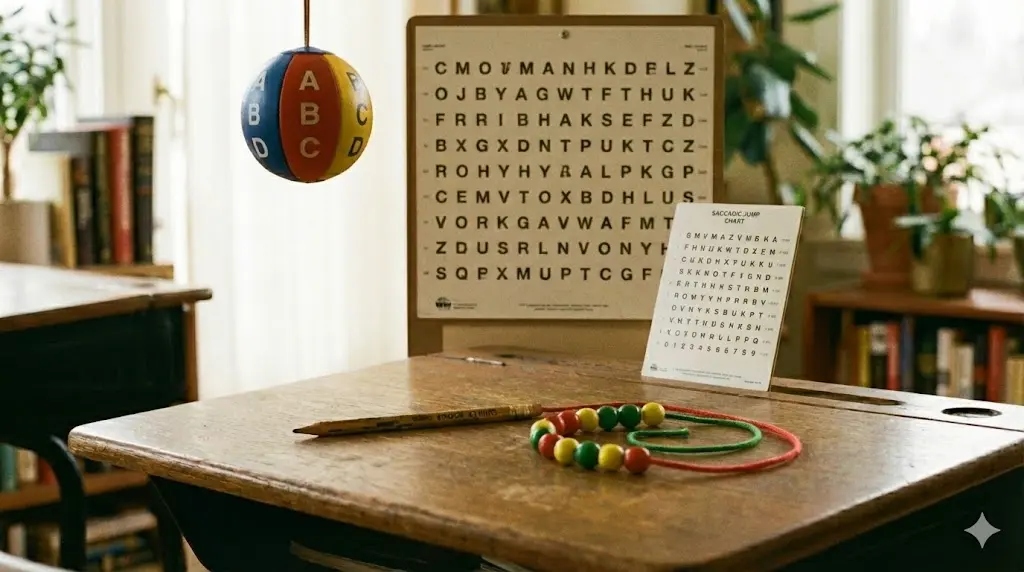
In this guide, we'll review low-tech exercises that target the visual skills athletes actually need: convergence, tracking, saccades, accommodation, and depth perception. These are the same foundational exercises used in optometric vision therapy, adapted for athletic performance. There are a few tools you may want to buy (they’re all pretty cheap on Amazon), and we include free resources to print for kitting out your office wall for saccadic jumps training and some basic divergence/convergence exercises.
We still think that 3DVisionGym.com let’s you turn your training up to 11. And it’s fun! But there are plenty of worthwhile other tools. Since knowledge is power we’re going to try to summarize a lot of good intel in one spot.
Before You Start
A few ground rules:
- Stop if you experience pain, headaches, or significant eye strain. Mild fatigue is normal; discomfort is a signal to rest.
- Take breaks. The 20-20-20 rule applies: every 20 minutes, look at something 20 feet away for 20 seconds.
- Use a metronome app for exercises that benefit from rhythm. Most smartphones have free options—set it between 60-120 BPM depending on the exercise and your current ability.
- Train consistently. Five minutes daily beats thirty minutes once a week.
- Work in good lighting. Your visual system has to work harder in dim conditions, which can mask or exaggerate problems.
Visual training exercises are designed to challenge and develop eye movement skills. They are not medical treatment and do not replace professional eye care. If you have concerns about your vision or eye health, consult a qualified eye care professional.
Pencil Push-Ups (Convergence Training)
What You'll Need
- A pencil, pen, or any small object with a clear focal point (a letter or mark helps)
What It Trains
Convergence—the ability of both eyes to turn inward simultaneously to focus on a near target. Poor convergence causes double vision at close range, difficulty with depth perception, and eye fatigue.
How to Do It
- Hold the pencil at arm's length, directly in front of your nose.
- Focus on the tip (or a letter written on it).
- Slowly bring the pencil toward your nose while maintaining single, clear vision.
- Stop when the image doubles or one eye loses focus—this is your "break point."
- Hold for 2-3 seconds, then slowly push back out.
- Repeat 10-15 times per session.
Progression: As your convergence improves, your break point should move closer to your nose. Track this distance over weeks.
Sports Applications
- Baseball/Softball: Tracking the ball from pitcher's release to the plate
- Golf: Maintaining focus on the ball through address and backswing
- Tennis/Racquet Sports: Keeping the ball clear as it approaches for contact
- Shooting Sports: Transitioning focus between sights and target
Brock String
What You'll Need
- A 6-10 foot string with 3-5 colored beads (or buttons, or anything you can slide on the string). You can make your own or buy low cost ones at Amazon.
What It Trains
Vergence control and suppression detection. The Brock String reveals whether one eye is "switching off" during binocular vision (suppression) and trains smooth convergence/divergence transitions.
How to Do It
- Tie one end of the string to a fixed point at eye level (doorknob, hook).
- Space the beads at different distances—say 6 inches, 2 feet, and 4 feet from your nose.
- Hold the other end of the string against the tip of your nose.
- Focus on the nearest bead. You should see two strings forming an "X" that crosses at the bead.
- Shift focus to the middle bead—the X should now cross there.
- Shift to the farthest bead.
What to watch for: If you see only one string (not an X), one eye is suppressing. If the X crosses in front of or behind the bead, your vergence is off. These are diagnostic clues, not failures—they tell you what to work on.
Sports Applications
- Clay Target Shooting: Smooth focus transitions between gun and target
- Baseball: Tracking pitches through the zone
- Hockey/Soccer Goalkeeping: Maintaining binocular lock on shots from various distances
- Basketball: Depth judgment on shots and passes
Marsden Ball
What You'll Need
- A ball (tennis ball, softball, or any ball you can write on)
- String to hang it from a ceiling hook or doorframe
- A marker to write letters or numbers on the ball
- You can buy a Marsden ball with lettering and string attached on Amazon
What It Trains
Smooth pursuit tracking, accommodation, and head-eye coordination. The Marsden Ball is a classic optometric tool for training the eyes to follow a moving target without losing focus.
How to Do It
- Write letters, numbers, or symbols in various sizes on the ball.
- Hang it at eye level so it can swing freely.
- Set the ball swinging (start with small arcs).
- Keep your head still and follow the ball with your eyes only—call out the letters as you track.
- Progress to larger swings, different swing patterns (diagonal, circular), and smaller letters.
Variations:
- Touch the ball with a finger while calling out letters (adds hand-eye component)
- Use a metronome and touch the ball on each beat
- Stand on an unstable surface (balance board, pillow) while tracking
Sports Applications
- Baseball/Cricket: Tracking ball flight off the bat or bowler
- Tennis: Following the ball through serve and rally
- Clay Shooting: Tracking target trajectory
- Lacrosse/Hockey: Following puck or ball through traffic
- Golf: Keeping eyes on the ball during the swing
Saccadic Jump Fixations
What You'll Need
- A handheld letter chart (download a free example here)
- A wall-mounted or door-posted letter chart (download below)
What It Trains
Saccades—rapid, accurate eye jumps between fixed points. Saccadic speed and accuracy affect how quickly you can scan a field of play, read a defense, or locate a target.
How to Do It
Version 1: Near-Far Jumps
- Hold the handheld chart at reading distance.
- Post the wall chart at eye level, 10-15 feet away.
- Fixate on a letter on the near chart—wait for clarity.
- Jump to a specific letter on the far chart—wait for clarity.
- Alternate, using a metronome to set pace (start slow, build speed).
Version 2: Horizontal Jumps (Doorframe Reading)
- Post letter strips on both sides of a doorframe at eye level. Just cut one column out from the saccadic jumps download so you have letters on the left and right side of a doorframe running top to bottom.
- Stand centered, 3-5 feet back.
- Fixate on the top letter on the left—wait for clarity.
- Jump to the top letter on the right—wait for clarity.
- Move down one letter on the right, then jump back left.
- Continue in a zigzag pattern down both strips.
Progression: Smaller letters, faster pace, larger distances between targets.
Sports Applications
- Quarterbacks: Scanning receivers across the field
- Basketball: Reading the floor, finding open teammates
- Clay Shooting: Acquiring targets quickly at different stations
- Soccer/Hockey: Scanning for passing options
- Cycling/Motorsports: Checking mirrors, gauges, and road ahead rapidly
Here’s what part of a saccade chart looks like. Click the download below to print your own high resolution set at home.

** Download: Saccade Charts (PDF) **
Fusion Training: Divergence and Convergence Exercises
The Fusion Chart is one of the simplest and most effective tools for training vergence—your eyes' ability to turn inward (converge) or outward (diverge) in a coordinated way. This skill is fundamental to depth perception, comfortable near work, and smooth focus transitions at any distance.
What You'll Need
- Offline Fusion Chart (download an example here - you’ll want to print it in color if possible)
- A well-lit room
- 5-10 minutes
Understanding the Exercise
The chart has five rows of circle pairs—green on the left, red on the right. Each row increases in difficulty, with the circles spaced farther apart as you move down.
Your goal is to "fuse" the two circles into three: you'll see the green circle on the left, the red circle on the right, and a new fused circle in the center. This center circle is the magic—it's your brain combining the images from both eyes.
The fused center circle will appear different depending on which technique you use:
- Divergence: The center circle appears to float behind the page
- Convergence: The center circle appears to float in front of the page
Both skills matter. Divergence is what you use when shifting focus to distant objects; convergence is what you use for near tasks.
Method 1: Divergence (Looking "Through" the Page)
Divergence means your eyes are pointing slightly outward, as if focusing on something far behind the chart. This is the same thing that happens when you stare off into the distance.
How to Do It
- Hold the chart at arm's length, roughly 16-20 inches from your face.
- Relax your eyes and look "through" the page, as if you're gazing at something on the wall behind it. Don't focus on the circles—let them go blurry.
- Let the circles drift. As your eyes diverge, you'll notice the two circles in each row start to move toward each other.
- Wait for the "pop." When your vergence is right, the circles will overlap and you'll suddenly see three circles: green on the left, a fused circle in the center, and red on the right.
- The fused center circle will appear to float behind the page—like you're looking through a window at a circle that's farther away.
- Hold the fusion. Once you've locked onto the 3D effect, try to keep it stable for 5-10 seconds. Then relax and repeat.
Tips for Divergence
- It helps to start by actually looking at something in the distance, then slowly bringing the chart into your peripheral vision while maintaining that "far away" focus.
- If you wear glasses, try it both with and without them to see which is easier.
- The top row (closest circles) is easiest. Don't move to harder rows until you can reliably fuse the easier ones.
Method 2: Convergence (Looking "In Front Of" the Page)
Convergence means your eyes are pointing slightly inward, as if focusing on something between you and the chart. This is what happens when you look at your finger held close to your nose.
How to Do It
- Hold the chart at arm's length, roughly 16-20 inches from your face.
- Hold a finger (or a pen tip) between your eyes and the chart, about halfway between your face and the page.
- Focus on your fingertip. The circles on the chart behind your finger will go blurry and appear to double.
- Slowly move your finger toward your nose, keeping your eyes locked on it. As you do, notice the chart in the background—the circles will drift and overlap.
- When the circles fuse into three, hold that position. You can then slowly lower your finger while trying to maintain the fusion.
- The fused center circle will appear to float in front of the page—like a 3D object hovering between you and the chart.
Tips for Convergence
- The finger trick is training wheels. Once you get the feel for it, you'll be able to converge without the finger.
- You're essentially crossing your eyes slightly—but in a controlled way, not the exaggerated cross-eyed look.
- If you feel eye strain, you're working too hard. Relax and try again.
Progressing Through the Rows
Start with Row 1 (the smallest separation). This is the easiest to fuse because your eyes don't have to diverge or converge as much.
Once you can:
- Achieve fusion within a few seconds
- Hold it steadily for 10+ seconds
- Switch between divergence and convergence at will
...move down to the next row. Each row requires a greater vergence range, which builds your flexibility and stamina.
Don't rush. Some people breeze through all five rows in a session; others spend a week on Row 2. Both are normal. The goal is control, not speed.
What You're Training
Skill | Why It Matters |
|---|---|
Vergence range | How far your eyes can turn in or out while staying coordinated |
Vergence flexibility | How quickly you can shift between convergence and divergence |
Fusion stability | How long you can maintain binocular lock on a target |
Suppression awareness | Noticing if one eye "turns off" during binocular tasks |
Sports Applications
Sport | How Vergence Helps |
|---|---|
Baseball/Softball | Tracking pitches requires rapid convergence as the ball approaches |
Golf | Shifting focus from ball (near) to fairway (far) to green (far) |
Basketball | Judging pass distances, depth on shots |
Shooting sports | Transitioning between sights (near) and target (far) |
Tennis/Racquet sports | Ball tracking through the full flight path |
Driving | Dashboard to road to mirrors—constant vergence shifts |
Common Problems
"I can only see two circles, not three." Your eyes aren't diverging or converging enough—or they're not doing it symmetrically. Try the finger method for convergence, or the "look through the page" technique for divergence. Start with Row 1.
"I see four circles." You've gone too far. Your eyes are over-diverged or over-converged. Relax and let them drift back toward normal.
"The fused circle keeps breaking apart." That's normal early on. Fusion stability takes practice. Try holding for just 2-3 seconds at first and build up.
"One eye seems to take over." This is called suppression—one eye is "turning off." It's common and worth being aware of. If it's persistent, consider seeing a vision specialist.
"I get a headache." You're working too hard or too long. Keep sessions short (5-10 minutes max), take breaks, and don't force it.
Sample Training Routine
Daily practice (5-10 minutes):
- Start with Row 1
- Achieve divergence fusion—hold 10 seconds
- Relax, then achieve convergence fusion—hold 10 seconds
- Repeat 3 times
- Move to Row 2 and repeat
- Progress as far as you can maintain clean fusion
- End the session if you feel strain
Weekly goal: Add one row, or increase hold time by 5 seconds
Download: Offline Fusion Chart (PDF) [sample of what you’re getting is below]

Peripheral Tracking with Central Fixation
What You'll Need
- A fixed point to focus on (a dot on a wall, a stationary object)
- A moving object in your environment (ceiling fan, pendulum, or a friend moving an object)
What It Trains
Peripheral awareness while maintaining central focus—critical for field sports where you must watch the ball while monitoring other players.
How to Do It
- Fix your gaze on a stationary point at eye level.
- Without moving your eyes, become aware of a moving object in your peripheral vision.
- Track the movement peripherally while maintaining hard central focus.
- Call out when the peripheral object changes direction or speed.
Real-world version: Fixate on a distant point while standing near a road. Track passing cars in your peripheral vision. (Safely—don't do this in traffic.)
Training version: Have a partner move a colored ball slowly through your peripheral field while you fixate centrally. Call out when they change direction or switch hands.
Sports Applications
- Basketball: Watching the ball handler while tracking cutters
- Soccer: Focusing on your mark while seeing the ball
- Hockey: Tracking the puck while seeing developing plays
- Football (any position): Ball focus with peripheral player awareness
- Driving: Focus ahead while monitoring mirrors and roadside
Straw-and-Bead Threading
What You'll Need
- A drinking straw
- a thin stick that fits inside the straw → a thin wooden cooking skewer should work
What It Trains
Depth perception and fine binocular coordination. This tasks your vergence system with a precision goal that provides immediate feedback.
How to Do It
- Hold the straw in one hand at arm's length.
- Hold the bead/string in the other hand, also at arm's length.
- Bring them together and thread the thin stick through the straw opening.
- Vary the distance—start close, move farther out.
- Try with one eye closed, then both eyes—notice the difference.
Progression: work at different distances, add time pressure.
Sports Applications
- Golf: Distance judgment to the pin
- Baseball: Bat-to-ball coordination
- Archery/Shooting: Fine aim adjustments
- Basketball: Judging pass distances
- Pool/Billiards: Cue-to-ball alignment
Balance Integration (Any Vision Exercise + Instability)
What You'll Need
- Any of the above exercises
- An unstable surface: balance board, foam pad, BOSU ball, or even just standing on one foot
What It Trains
Vestibular-visual integration. Your balance system and visual system are deeply linked. Training them together builds the kind of stable vision athletes need when their bodies are in motion.
How to Do It
- Perform any of the above exercises while standing on an unstable surface.
- Start easy—one foot on firm ground—and progress to more challenging surfaces.
- The visual exercise should be one you can already do well on stable ground.
Sports Applications
- All sports involving movement. Seriously—all of them. Your eyes have to work while your body moves.
Building Your Routine
You don't need to do everything every day. Here's a sensible framework:
Daily (5-10 minutes):
- Pick 2-3 exercises that target your weakest areas
- Use a metronome to add structure
- Track your progress (break points, speed, accuracy)
Weekly rotation:
- Cycle through all exercises over the course of a week
- Reassess which skills need the most work
Signs you're progressing:
- Pencil push-up break point moving closer
- Faster metronome speeds with maintained accuracy
- Clearer, faster focus shifts
- Reduced eye fatigue
Signs you need to back off:
- Persistent headaches
- Eye strain that doesn't resolve with rest
- Double vision that persists after exercises
When to See a Professional
These exercises are safe for most people, but they're not a substitute for professional care. This is not medical advice. See a sports vision optometrist or vision therapist if:
- You have persistent double vision
- These exercises cause consistent pain or headaches
- You have a known eye condition (strabismus, amblyopia, etc.)
- You're not seeing improvement after 4-6 weeks of consistent training
A professional can identify specific deficits and create a targeted program—these general exercises are a solid starting point, but everyone's visual system is different.
The Bottom Line
Fancy equipment isn't what makes vision training effective—consistency and progressive challenge are. A pencil, a string with beads, and a few letter charts can deliver real improvements in convergence, tracking, saccades, and depth perception. These are the visual skills that separate good athletes from great ones.
Start with what's easy. Progress when it gets boring. And pay attention to what your eyes are telling you.
Checkout 3DVisionGym when you want to add some flair and kick things up a notch! We think it’s a worthwhile add on beyond the basic age old tools. But we’re not gonna lie and say it’s the only way to work on your dynamic vision.
The methods on this page and 3DVisionGym are a training tool for visual skills relevant to athletic performance—not a medical device. They do not diagnose, treat, or prevent any medical condition. If you have concerns about your vision or eye health, see a qualified eye care professional.