Hockey Vision: How Goalies and Forwards Read the Ice

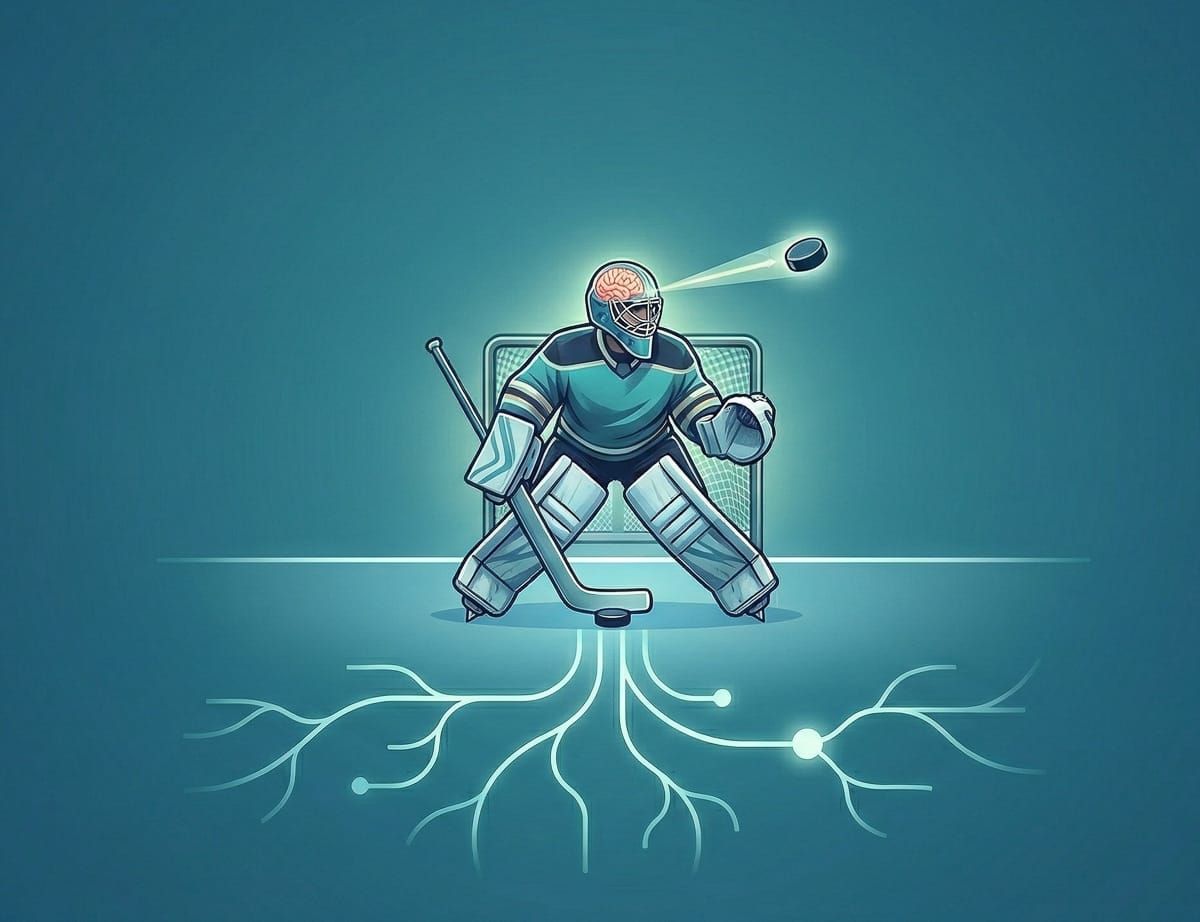
A 100 mph slap shot from the blue line reaches the net in under half a second. A goaltender facing that shot through two bodies and a screen has roughly 400 milliseconds to locate the puck, process its trajectory, and initiate a save. The difference between elite and average at this level is not physical reflexes. It is how the eyes gather information before the shot is released.
Hockey is one of the fastest team sports played on a defined surface. The puck moves at speeds that collapse the available reaction window to the edge of human capability. Players skate at 20+ mph, shift directions constantly, and operate in a 200-by-85-foot environment where threats arrive from every angle. The visual demands are extreme -- and largely invisible to fans, coaches, and often the players themselves.
What separates elite performers in hockey is not some genetic gift of faster reflexes. The research points elsewhere. Elite goalies, forwards, and defensemen organize their visual attention differently. They fixate on different locations, at different times, for different durations. They extract more information from fewer glances. And these visual strategies appear to be trainable.
The Visual Problem of Hockey
Consider what a goaltender actually faces. An NHL slap shot averages around 90 mph, with the hardest shooters reaching over 100 mph [1]. From the blue line -- roughly 60 feet away -- that gives the goaltender approximately 450 milliseconds of puck flight time. But human visual reaction time -- the interval between seeing a stimulus and initiating a motor response -- averages around 200 milliseconds [2]. That leaves roughly 250 milliseconds to locate the puck, calculate its trajectory, and select a save movement. A quarter of a second.
Now add traffic. In modern NHL hockey, the area in front of the net is a permanent construction zone. Offensive players drive the net, set screens, tip shots, create deflections. The goaltender must track a black disk three inches in diameter as it moves through and behind bodies that are themselves moving. The puck disappears and reappears. Its trajectory changes when deflected. The visual system must handle pursuit tracking, occlusion, saccadic re-acquisition, and trajectory prediction -- simultaneously, at speed, under competitive pressure.
For skaters, the visual demands are different but equally intense. A center carrying the puck up ice must monitor his own puck handling (near vision), track the positioning of defenders (mid-range vision), spot passing lanes developing across an 85-foot-wide surface (peripheral vision), and anticipate the goaltender's positioning at the far end of the rink. That requires constant shifting between near, mid, and far focal distances -- a vergence task that repeats dozens of times per shift.
Defensemen face a depth perception challenge that coaches call gap control: maintaining the right distance between themselves and an oncoming forward, typically two to three stick lengths, while skating backward [3]. Close the gap too slowly, and the forward blows past. Close it too aggressively, and you are exposed to a deke. Accurate distance judgment at closing speeds of 30+ mph combined, on a low-friction surface where stopping distance is measured in body lengths, makes this a demanding depth perception task in team sports.
How Goalies Track the Puck
The most detailed research on goaltender visual behavior comes from Joan Vickers and Derek Panchuk at the University of Calgary, who used wireless eye-tracking headgear to record where goalies actually look during shots.
Their 2006 study in Human Movement Science examined eight fixation and tracking locations -- the shooter's head, upper body, lower body, the puck, the stick, the puck-stick combination, the ice in front of the release point, and the ice near the goal [4]. The findings were striking. The most successful goalies locked their gaze directly on the puck for as much as a full second before the shot was released, and this fixation was unbroken through the onset of the saving movement.
Vickers calls this the "quiet eye" -- a final fixation on a task-relevant location, within 3 degrees of visual angle, lasting at least 100 milliseconds, occurring prior to the critical movement phase [5]. In goaltending, the quiet eye manifests as an early, sustained lock on the puck-on-stick. Elite goalies initiate this fixation earlier and hold it longer than less skilled goalies. When goalies successfully make a save, they begin their final fixation slightly earlier than when they are scored on. The temporal margin is small -- fractions of a second -- but the performance difference is consistent.
Less skilled goalies, by contrast, scatter their gaze. They look at the shooter's body, the ice, the surrounding players. By the time they locate the puck, the shot is already in flight and the reaction window has shrunk further. The problem is not that they are slower. The problem is that they are looking at the wrong things at the wrong times.
Tracking Through Screens
Screens introduce the hardest visual problem in goaltending: occlusion and re-acquisition. When a player's body blocks the goaltender's line of sight to the puck, the visual system must maintain a predictive model of where the puck is and where it is going, then rapidly re-acquire the actual puck when it reappears from behind the screen.
This demands two distinct visual skills working in sequence. First, smooth pursuit tracking to follow the puck's trajectory before it disappears. The quality of this pursuit determines the accuracy of the brain's predictive model during occlusion. Second, a fast saccade -- a rapid, ballistic eye movement -- to the predicted location when the puck should reappear, followed by immediate re-acquisition and resumed tracking [6].
Research on object tracking during occlusion shows that athletes make predictive eye movements that scale with visual target properties like speed and acceleration [7]. The brain does not simply wait for the object to reappear. It anticipates the reappearance location based on the pre-occlusion trajectory. Better pre-occlusion tracking leads to more accurate prediction leads to faster re-acquisition.
Panchuk, Vickers, and Hopkins extended this work in a study on deflected shots -- pucks that changed direction after hitting a board placed to the goaltender's left or right, producing trajectories with low predictability [8]. Even for these unpredictable deflections, goalies who located the puck earlier and maintained their gaze on the puck-stick location longer were more successful. The optimal quiet eye onset was approximately two seconds before the shot release, with an optimal duration extending 2 to 2.3 seconds into the shot's flight. Two seconds of sustained visual attention may not sound like much, but in a sport where shifts last 45 seconds and the puck changes possession every few seconds, maintaining that sustained focus amid chaos is a distinct skill.
How Forwards and Centers Read the Ice
Wayne Gretzky famously said he skated to where the puck was going, not where it had been. This has been repeated so often it has become a cliche, but the underlying visual mechanism is specific and measurable: anticipatory gaze behavior driven by peripheral vision and pattern recognition.
Gretzky said that if you ask a fifty-goal scorer what the goalie looks like, the answer is that the goalie is "just a blur" -- nothing but net [9]. He was not looking at the goalie with foveal (central) vision but processing the goalie's position through peripheral vision while his central gaze was directed elsewhere. This is a hallmark of expert visual behavior in dynamic environments: using peripheral vision to monitor the global scene while foveal vision extracts detail from the most critical location.
The Martell and Vickers (2004) study on defensive tactics in ice hockey documented a specific gaze strategy that distinguished elite from near-elite players [10]. The researchers placed cameras in helmets to measure eye movements during live play. Elite defensemen used a two-glimpse strategy: one early, rapid glimpse while approaching the puck carrier to map the tactical situation and formulate a plan, followed by a second brief glimpse upon reaching the puck to verify the plan was still valid. Near-elite and lower-level players used only a single glimpse -- when they arrived at the puck -- giving them less time to process the tactical situation and a less flexible response.
This two-glimpse pattern suggests that elite hockey vision is not about seeing more. It is about temporal organization -- looking at the right things in the right sequence, extracting information efficiently, and building a tactical model that allows decision-making before the critical moment arrives.
For forwards, the visual workload during offensive play involves constant vergence shifting. Handling the puck requires near vision (the puck is roughly 3-4 feet from the eyes in a normal skating posture). Reading the defense requires mid-range vision (10-30 feet). Spotting an open teammate across the ice or reading the goaltender's positioning requires far vision (40-100 feet). Each shift in focal distance requires a vergence adjustment -- the eyes must converge or diverge to maintain binocular fusion at the new distance. A forward executing a give-and-go play might shift focal distance five or six times in two seconds: puck, passing target, back to puck, defender, net, release point.
Defensemen and the Depth Perception Challenge
Gap control is the defensive fundamental that most directly tests depth perception. A defenseman skating backward must judge the distance to an oncoming forward, estimate the forward's speed, calculate closing speed (the sum of both players' velocities), and choose the precise moment to commit to a play -- either stepping up to close the gap or pivoting to skate alongside.
The distance involved is typically 10-30 feet, well within the range where binocular stereopsis provides useful depth information. The problem is that both athletes are moving, often at 15-20 mph each, on a low-friction surface. A misjudgment of two feet -- the difference between making a play and getting beaten -- represents a timing error of roughly 50-70 milliseconds at those closing speeds.
Coaches describe this as a "reads" problem, framing it in terms of hockey IQ. But the foundation is visual. If the defenseman cannot accurately perceive the distance between himself and the forward, and accurately perceive how quickly that distance is shrinking, no amount of tactical knowledge helps. The read starts with the eyes.
What the Research Shows
The most direct evidence connecting visual skills to hockey performance comes from Poltavski and Biberdorf's 2015 study of 38 Division I collegiate hockey players [11]. Using the Nike SPARQ Sensory Training Station, they measured visual reaction time, visual memory, visual discrimination, and near-far focus shifting ability (accommodative/vergence facility), then correlated these measures with actual game statistics over two seasons.
The headline finding: 69% of the variance in goals scored by forwards could be predicted by four visual measures -- faster reaction time to visual stimuli, better visual memory, better visual discrimination, and faster ability to shift focus between near and far objects. A 69% explained variance is unusual in sport science, where 30-40% is considered strong.
The near-far focus shifting measure is particularly relevant. It maps directly to the vergence demands of offensive play -- the constant back-and-forth between puck, teammates, defenders, and net. Players who could shift focus faster scored more goals. Not because focus shifting directly causes goals, but because faster focus shifting allows the player to gather more visual information per unit of time, which enables better tactical decisions, which creates more scoring opportunities.
Poltavski later expanded this research with a 2021 study combining sports vision training with traditional optometric vision therapy protocols in youth hockey players [12]. After 10 weeks of visual training, players showed measurable changes in electrophysiological markers of visual processing -- specifically, decreased P100 amplitude to visual stimuli and decreased theta-gamma ratios during perception, Go/No-Go, and reaction time tasks. These neurophysiological changes suggest greater efficiency in visual information processing and cognitive resource allocation. The visual system was not just performing better on tests; it was processing information with less neural effort.
Trainable Visual Skills for Hockey
Mapping the research to specific training categories:
Smooth Pursuit Tracking
The ability to follow a moving object with a steady, continuous eye movement. This is the foundation of puck tracking. When pursuit is accurate, the puck's image stays on the fovea, providing the highest-resolution visual input. When pursuit breaks down -- the eye falls behind the puck or oscillates around it -- the image blurs and the brain loses trajectory information. Smooth pursuit accuracy can be trained, and the research suggests that more accurate pursuit produces better prediction of an object's trajectory [13]. For goalies, this means better pre-occlusion tracking and better predictive modeling when the puck disappears behind a screen.
Saccadic Speed and Accuracy
Saccades are the fast, ballistic eye movements that jump between fixation points. Hockey requires constant saccadic activity: scanning the ice, checking over the shoulder, relocating the puck after a screen, shifting gaze between near and far targets. Training saccadic speed and accuracy improves the rate at which a player can sample the visual environment. Faster, more accurate saccades mean more visual information gathered per second, which feeds directly into tactical awareness and decision-making.
Vergence Facility
The speed and accuracy of convergence (eyes rotating inward for near targets) and divergence (eyes rotating outward for far targets). This is the near-far focus shifting that Poltavski's research linked to goal scoring. Vergence facility is one of the most trainable visual skills, with the Convergence Insufficiency Treatment Trial demonstrating significant improvement in 73% of patients after 12 weeks of structured training [14]. For hockey, faster vergence means less time spent re-fusing visual targets after a focal distance change, which means smoother transitions between puck handling, ice reading, and shooting.
Peripheral Awareness
The ability to detect and process visual information outside the central 2-3 degrees of foveal vision. Peripheral vision provides the "big picture" that allows a player to read the ice while maintaining foveal focus on the puck or a specific tactical location. A University of Cincinnati study found that when athletes participated in peripheral vision and sports vision training, the overall number of concussions dropped by 80% over four seasons -- the broader functional awareness helped players anticipate and avoid collisions [15]. For hockey, training peripheral awareness may improve both tactical vision and on-ice safety.
Depth Perception
The combination of stereopsis (binocular depth from disparity) and motion-based depth cues that allows accurate distance judgment. Critical for gap control, shot timing, and pass accuracy. Binocular depth training -- exercises that require the brain to fuse stereo images and discriminate depth differences -- can sharpen stereoacuity and improve the accuracy of distance judgments within the relevant range of hockey play (roughly 3-60 feet).
Position-Specific Training Recommendations
Goalies
The primary visual demands are pursuit tracking (following the puck), saccadic re-acquisition (finding the puck after occlusion), and peripheral awareness (monitoring traffic in front of the net while tracking the puck). Quiet eye research suggests that goalies may benefit most from training sustained fixation under pressure -- the ability to lock onto the puck-on-stick early and hold that fixation through the shot release, even with visual distractions and screens.
A goaltender training program might emphasize smooth pursuit exercises at progressively higher speeds and with increasing occlusion intervals, paired with saccadic training that requires rapid target re-acquisition. Depth of field exercises that test the ability to detect which object is at a different distance can also train the kind of stereo depth judgment used when the puck is moving toward or away from the goalie (the hardest trajectory to judge visually because the retinal image change is minimal).
Forwards and Centers
Near-far vergence facility is the standout visual predictor of offensive performance in the research. Training should emphasize rapid convergence-divergence cycling -- shifting focus between near and far targets with decreasing transition times. This maps directly to the in-game demand of shifting attention between puck, ice, and net.
Peripheral awareness training may also help forwards develop Gretzky-like ice sense -- the ability to process the defensive structure through peripheral vision while foveal attention is directed at the puck. Saccadic training focused on multi-target scanning (tracking multiple moving objects and shifting attention between them rapidly) simulates the visual demands of reading a developing play.
Defensemen
Gap control is fundamentally a depth perception task, so binocular depth training is the priority. Exercises that require discriminating depth differences between objects at mid-range distances (10-30 feet equivalent) map most directly to the gap control demand. Vergence exercises build the binocular fusion that underlies accurate depth judgment.
Defensemen also benefit from the two-glimpse scanning strategy described in Martell and Vickers' research. Training could include exercises that require extracting information from brief visual exposures -- seeing a scene, looking away, and recalling key spatial relationships. This builds the rapid information extraction that elite defensemen use during their early glimpse.
What This Means in Practice
Vision training for hockey is not about eye exercises in isolation. The research consistently shows that the athletes who perform best visually are not the ones with the fastest raw reaction times or the sharpest static visual acuity. They are the ones who organize their visual attention most effectively -- who look at the right things, in the right order, at the right time, and extract the most information from each glance.
That organizational skill has a foundation in basic visual capabilities: smooth pursuit accuracy, saccadic speed, vergence facility, peripheral sensitivity, stereo depth discrimination. When these foundational skills are sharper, the higher-level tactical vision has better raw material to work with. A goalie with precise pursuit tracking builds a more accurate predictive model during occlusion. A forward with fast vergence facility gathers more visual information per shift. A defenseman with acute depth perception makes gap control decisions with less uncertainty.
Platforms like 3DVisionGym train these component visual skills through exercises in convergence, divergence, smooth pursuit, saccadic speed, depth of field, pursuit tracking, and peripheral awareness. Together, these build the visual foundation that supports on-ice performance. The training is not a replacement for hockey-specific practice. It is the visual conditioning that makes the hockey-specific practice more productive – the same way strength training does not replace skating drills but makes the athlete more capable when performing them.
The evidence is strong for individual skill improvement and suggestive for on-ice transfer, though more intervention studies are needed. Poltavski's correlational findings are strong, but more intervention studies -- training a visual skill and measuring the on-ice performance change -- are needed to establish definitive causal links. The quiet eye research from Vickers' lab provides the clearest evidence that visual strategy directly determines performance outcomes in specific hockey tasks. What remains to be established at scale is how much general visual training transfers to sport-specific improvement.
What is clear is that hockey demands visual performance at the edge of human capability, that elite players use measurably different visual strategies than non-elite players, and that the foundational visual skills underlying those strategies are trainable. For any serious hockey player, ignoring visual training means leaving a significant performance variable unaddressed.
Disclaimer
3DVisionGym is a vision training tool, not a medical device. It is not a substitute for professional eye care. The visual training described in this article is intended to complement athletic development, not replace evaluation or treatment by a qualified eye care professional. If you have concerns about your vision or experience symptoms like eye strain, headaches, or double vision, see an optometrist or ophthalmologist. Individual results from vision training vary.
References
[1] NHL EDGE IQ. Estimating Shot Speed by Shot Type. Data from NHL puck-tracking system. Average NHL slap shot velocity approximately 85-95 mph, with elite shooters exceeding 100 mph. Zdeno Chara holds the NHL Skills Competition record at 108.8 mph.
[2] Exploratorium. "Science of Hockey: Goalie Reaction Time." Average human visual reaction time approximately 200 milliseconds. Best NHL goalies can initiate a response in approximately 100-140 milliseconds on close-range shots. https://annex.exploratorium.edu/hockey/save1.html
[3] Human Kinetics. "Gap Control." Excerpt on defensive positioning technique, maintaining 2-3 stick lengths between defenseman and oncoming forward. https://us.humankinetics.com/blogs/excerpt/gap-control
[4] Panchuk, D., & Vickers, J.N. (2006). Gaze behaviors of goaltenders under spatial-temporal constraints. Human Movement Science, 25(6), 733-752. doi:10.1016/j.humov.2006.07.001
[5] Vickers, J.N. (2007). Perception, Cognition, and Decision Training: The Quiet Eye in Action. Human Kinetics. Quiet eye defined as a final fixation within 3 degrees of visual angle, at a task-relevant location, lasting at least 100ms, prior to movement initiation.
[6] Hayhoe, M.M. (2017). Vision and Action. Annual Review of Vision Science, 3, 389-413. On predictive eye movements and saccadic re-acquisition during object tracking and occlusion.
[7] Land, M.F., & McLeod, P. (2000). From eye movements to actions: how batsmen hit the ball. Nature Neuroscience, 3(12), 1340-1345. Demonstrates predictive saccades scaling with target velocity during tracking.
[8] Panchuk, D., Vickers, J.N., & Hopkins, W.G. (2017). Quiet eye predicts goaltender success in deflected ice hockey shots. European Journal of Sport Science, 17(1), 93-102. doi:10.1080/17461391.2016.1156160
[9] Gretzky, W., & Reilly, R. (1990). Gretzky: An Autobiography. HarperCollins. Gretzky on how fifty-goal scorers perceive the goalie as "just a blur" -- seeing net rather than goalie, and on his peripheral awareness: "People say I've got great peripheral vision. It's just awareness."
[10] Martell, S.G., & Vickers, J.N. (2004). Gaze characteristics of elite and near-elite athletes in ice hockey defensive tactics. Human Movement Science, 22(6), 689-712. doi:10.1016/S0167-9457(04)00006-5
[11] Poltavski, D., & Biberdorf, D. (2015). The role of visual perception measures used in sports vision programmes in predicting actual game performance in Division I collegiate hockey players. Journal of Sports Sciences, 33(6), 597-608. doi:10.1080/02640414.2014.951952
[12] Poltavski, D., Biberdorf, D., & Praus Poltavski, C. (2021). Which Comes First in Sports Vision Training: The Software or the Hardware Update? Utility of Electrophysiological Measures in Monitoring Specialized Visual Training in Youth Athletes. Frontiers in Human Neuroscience, 15, 732303. doi:10.3389/fnhum.2021.732303
[13] Spering, M., Schutz, A.C., Braun, D.I., & Gegenfurtner, K.R. (2011). Keep your eyes on the ball: smooth pursuit eye movements enhance prediction of visual motion. Journal of Neurophysiology, 105(4), 1756-1767. doi:10.1152/jn.00344.2010
[14] Convergence Insufficiency Treatment Trial (CITT) Study Group. (2008). Randomized clinical trial of treatments for symptomatic convergence insufficiency in children. Archives of Ophthalmology, 126(10), 1336-1349. doi:10.1001/archopht.126.10.1336
[15] Clark, J.F., Ellis, J.K., Bench, J., Khoury, J., & Graman, P. (2012). High-performance vision training improves batting statistics for University of Cincinnati baseball players. PLoS ONE, 7(1), e29109. Related work: Clark et al. (2015). An exploratory study of the potential effects of vision training on concussion incidence in football. Optometry and Visual Performance, 3(2), 116-125. Reported 80% reduction in concussions at University of Cincinnati after four years of vision training.