Court Vision: How Elite Basketball Players See the Game Differently

Visual skills that separate playmakers from players - and how to develop them
Chris Paul throws a no-look bounce pass through three defenders to a cutting teammate for an easy layup. The arena erupts. Commentators call it "incredible court vision." But what does that actually mean?
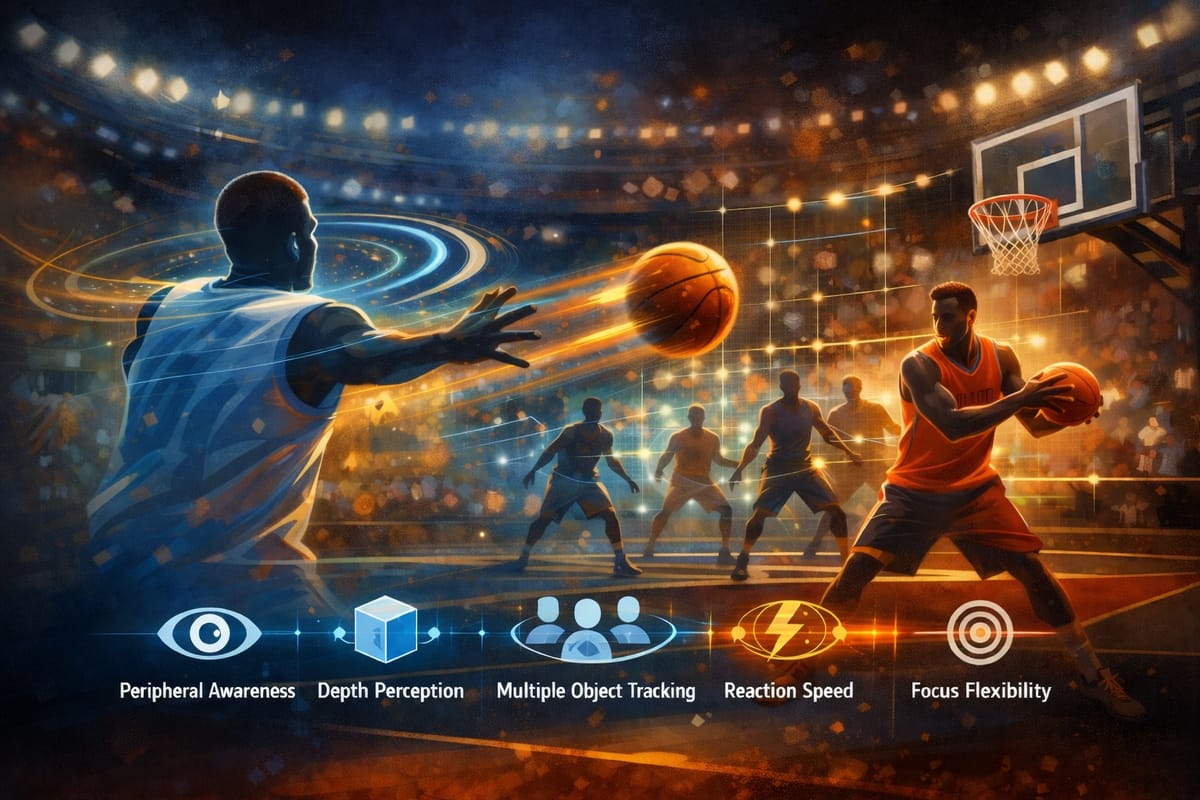
Court vision is not one skill. It is a constellation of visual and cognitive abilities working together in fractions of a second. When scouts praise a prospect's "court vision," they are really describing peripheral awareness, depth perception, multiple object tracking, visual reaction time, and the ability to process all of this information while executing complex motor tasks.
The good news: most of these components are trainable.
What "Court Vision" Actually Means
The term gets thrown around loosely. Point guards have it. Big men usually do not. But court vision is not some mystical gift you either possess or lack. Breaking it down reveals specific, measurable visual-cognitive skills.
Peripheral awareness: The ability to detect and process visual information outside your direct line of sight. When a point guard sees a backdoor cutter without looking away from the ball handler, that is peripheral awareness.
Depth perception: Judging distances accurately—how far away is that defender? Will this pass reach the shooter before the closeout? Binocular depth perception (using both eyes to triangulate distance) becomes critical for threading passes through tight windows.
Multiple object tracking (MOT): Maintaining awareness of several moving players simultaneously. A point guard running a pick-and-roll must track the ball handler, screener, rolling big, help defenders, and weakside shooters—all at once.
Visual reaction time: How quickly you detect and respond to visual stimuli. A defender jumping a passing lane, a help defender rotating late—reacting to these openings requires rapid visual processing.
Focus flexibility: The ability to shift focus between near and far distances quickly. Looking at the ball in your hands, then immediately focusing on a receiver 30 feet away, requires fast accommodation.
Elite basketball players typically excel in multiple dimensions. Average players often have one or two weak links that limit their effectiveness.
The Research on Elite Visual Processing
Studies comparing elite and recreational basketball players consistently show differences in visual-cognitive abilities. Research on expert basketball players has found they make fewer fixations but with longer duration, and their saccades (rapid eye jumps between fixation points) cover greater distances than novices—they extract more information per glance.
Research from Duke University's sports vision lab, led by Greg Appelbaum, has examined thousands of athletes using comprehensive visual-motor assessments. Their work has found that visual-motor performance correlates with competition level, and that athletes in strategic sports like basketball show particular advantages in spatial working memory (Appelbaum et al., 2016).
Interestingly, these advantages appear trainable. Perceptual learning research demonstrates that attention and visual processing speed improve with targeted practice, with some evidence of transfer to real-world tasks (Watanabe & Sasaki, 2015). The visual system is more plastic than previously believed.
Some research suggests elite athletes do not necessarily have sharper "hardware"—their retinas and visual acuity are not superior to average people. The difference lies in software: how they process, prioritize, and act on visual information. This is encouraging because it means court vision is largely about trained pattern recognition and attention allocation rather than genetic luck.
Peripheral Awareness: Seeing Without Looking
A point guard dribbling at the top of the key appears focused on the defender in front of them. Meanwhile, they are tracking a shooter in the corner, a big man sealing in the post, and help defenders shading toward the paint. None of this requires directly looking.
Human vision is divided into foveal (central) and peripheral regions. The fovea covers only about 2 degrees of your visual field but provides sharp, detailed vision. Everything outside that—your peripheral vision—is blurrier but covers nearly 180 degrees horizontally.
Elite playmakers learn to extract more information from their peripheral vision. They can detect movement, recognize player positioning, and anticipate rotations without shifting their gaze. This is trainable. Peripheral awareness drills teach your visual system to process information from the edges of your visual field without requiring direct fixation.
The research supports this. Studies on attention in sports show that experts use more distributed gaze patterns—they look at fewer specific locations but extract more total information because their peripheral processing is superior.
For basketball specifically, peripheral vision is essential for:
- Recognizing when help defense is coming
- Seeing cutters and shooters relocating
- Passing to teammates you are not looking at directly
- Defending without ball-watching
Depth Perception and Passing Accuracy
Every pass is a depth perception problem. You are not throwing to where a teammate is—you are throwing to where they will be when the ball arrives. This requires calculating distances, speeds, and trajectories in three-dimensional space.
Binocular depth perception relies on both eyes working together. The slight difference in each eye's view (binocular disparity) allows your brain to triangulate distances precisely. Athletes with refined depth perception make more accurate passes, particularly through traffic where windows are tight.
Consider a skip pass from one corner to the opposite wing. The passer must judge the distance accurately, account for the closing speed of defenders, and put the ball in a catchable location. Misjudge the depth by a few feet and the pass becomes a turnover.
Depth perception also affects shooting. While free throws and set shots allow time for calibration, catch-and-shoot situations require rapid distance assessment. The shooter must process how far they are from the basket while catching the ball, squaring up, and beginning their shooting motion—all in under a second.
Training depth perception challenges your binocular system with increasingly subtle distance differentials. Your brain learns to detect smaller depth differences more accurately, which translates to better spatial judgment on the court.
Tracking Multiple Players: The MOT Connection
Perhaps no basketball skill demands more from the visual system than tracking multiple players simultaneously. In a five-on-five environment with constant movement, a playmaker must maintain awareness of up to ten players at varying distances, moving in unpredictable patterns.
Multiple object tracking (MOT) research reveals that humans can typically track 3-4 independent objects moving through space. Elite athletes push this number higher. A landmark study by Faubert (2013) at the University of Montreal found that professional team-sport athletes demonstrated superior 3D-MOT performance compared to amateur athletes and non-athletes—they could track more objects at higher speeds.
The implications are significant. A point guard who can track four moving players while dribbling processes more information than one who can only track two. They see the extra pass, the late rotation, the back-door cut that others miss.
MOT appears to be one of the most trainable visual-cognitive skills. Research from Faubert's lab found that systematic MOT training improved performance not just on tracking tests but on downstream measures like attention and processing speed. The brain's capacity for divided attention can expand with practice—though it should be noted that transfer to actual game performance remains debated, with some follow-up studies failing to replicate initial positive findings (Romeas et al., 2024).
In 3DVisionGym, Swarm mode trains this exact capacity—tracking multiple targets moving through space while distractors attempt to confuse you. The underlying cognitive mechanisms are the same ones basketball players use when processing complex floor situations.
Visual Reaction Time: Jumping the Passing Lane
Steals and blocks require more than athleticism. You need to see the opportunity before it fully develops and initiate your response while it still exists.
Visual reaction time breaks into two components: sensory processing (how quickly your eyes detect the stimulus) and motor response (how quickly you begin moving). Elite defenders are fast at both.
Consider a defender anticipating a pass. They are not reacting to the ball leaving the passer's hands—by then it is too late. They are reading the passer's eyes, shoulders, and body position, detecting intent before the pass is thrown, and pre-loading their movement so they explode toward the passing lane the moment the ball is released.
This anticipatory skill has a visual foundation. Research shows that expert defenders fixate on different visual cues than novices. They look at torsos and hips rather than the ball, extracting predictive information about what will happen next. But even with superior anticipation, raw visual reaction speed determines whether they can convert that read into a deflection or steal.
Reaction time training pushes your visual system to detect and respond faster. The gains are incremental—you are not going to double your reaction speed—but even 20-30 milliseconds faster can make the difference between a fingertip deflection and a clean pass.
How These Skills Develop—and What We Actually Know
Here is where honesty matters. The sports vision training industry makes big claims. Some are supported by research; others are not.
What the research supports:
Peripheral awareness is trainable. Studies consistently show improvements in peripheral detection after systematic training, with some evidence of transfer to sport-specific tasks.
Multiple object tracking improves with practice. This is one of the more robust findings. MOT capacity expands with training, and improvements appear to transfer beyond the specific training task.
Visual processing speed can improve. Perceptual learning studies show meaningful gains in how quickly people process visual information, though the size of transfer to real-world performance remains debated.
Depth perception and vergence are trainable. The eye muscles and neural pathways involved in binocular depth perception respond to training like other motor systems.
What remains unclear:
How much transfer occurs to actual game performance. Laboratory improvements do not always translate to the court. The gap between "better at a visual task" and "better at basketball" exists, and research has not fully closed it.
Whether trained athletes benefit as much as untrained individuals. Some evidence suggests visual training has larger effects for novices than experts. If your visual system is already well-developed through years of sport experience, the marginal gains from additional training may be smaller.
Optimal training protocols. How often, how long, what intensity—these details remain under-researched. The programs that exist (including ours) are based on available evidence and practical experience, but not definitive dose-response data.
Practical Recommendations
Given what we know and do not know, here is a reasonable approach:
Assess your visual skills. Understanding your strengths and weaknesses allows targeted training. You might have excellent peripheral awareness but sluggish depth perception—or the reverse. Training everything equally is less efficient than addressing your actual weak links.
Train consistently rather than intensively. Ten minutes of focused visual training most days likely beats one long session per week. The visual system adapts through repeated exposure.
Include multiple components. Court vision is not one skill, so training should not target one skill. Peripheral awareness, depth perception, tracking, and reaction time all contribute. A balanced program addresses each.
Do not expect miracles. Visual training is one piece of a larger development puzzle. It will not transform a poor passer into Chris Paul. But if visual processing is a limiting factor in your game—and for many players it is—addressing that bottleneck can unlock improvements in other areas.
Track your progress. Improvement in visual skills is gradual and often not consciously noticeable. Objective measures help you see changes over time and identify when training is working.
The Bottom Line
Court vision is not mystical. It is peripheral awareness, depth perception, multiple object tracking, visual reaction time, and focus flexibility working in concert. These components are measurable, and most of them are trainable.
Elite basketball players process more visual information more quickly and more accurately than average players. Some of that advantage comes from years of sport-specific experience and pattern recognition. But the underlying visual-cognitive abilities can be developed through targeted training.
Whether you are a point guard trying to see the extra pass, a defender working on anticipation, or simply a player who feels "late" processing what is happening around you—your visual system is probably not operating at its ceiling. That ceiling can rise.
The question is whether you train it.
Visual training exercises are designed to challenge and develop eye movement skills relevant to athletic performance. They are not medical treatment and do not replace professional eye care. If you have concerns about your vision or eye health, consult a qualified eye care professional.
References
Appelbaum, L. G., & Erickson, G. (2018). Sports vision training: A review of the state-of-the-art in digital training techniques. International Review of Sport and Exercise Psychology, 11(1), 160-189.
Appelbaum, L. G., Schroeder, J. E., Cain, M. S., & Mitroff, S. R. (2011). Improved visual cognition through stroboscopic training. Frontiers in Psychology, 2, 276.
Faubert, J. (2013). Professional athletes have extraordinary skills for rapidly learning complex and neutral dynamic visual scenes. Scientific Reports, 3, 1154.
Faubert, J., & Sidebottom, L. (2012). Perceptual-cognitive training of athletes. Journal of Clinical Sport Psychology, 6(1), 85-102.
Romeas, T., Chaumillon, R., Labbé, D., & Bherer, L. (2024). No transfer of 3D-Multiple Object Tracking training on game performance in soccer: A follow-up study. Psychology of Sport and Exercise, 102770.
Watanabe, T., & Sasaki, Y. (2015). Perceptual learning: Toward a comprehensive theory. Annual Review of Psychology, 66, 197-221.